Trampoline Park Management Software: The Operator Guide
2026-05-04 · 7 min read
Party rooms, jump zones, waivers for every jumper, real-time capacity limits — trampoline parks are an operations problem. Here's what management software needs to handle and where most platforms fall short.
A birthday party of 15 kids shows up Saturday at 2pm. Half have waivers signed, half don't. The party room is double-booked because the online booking system and the front desk calendar weren't in sync. The jump zone is over capacity because nobody tracked how many day passes sold in real time.
Trampoline parks are an operations problem first. The jumping is easy. The scheduling, waivers, party management, and capacity tracking are where parks lose money, create liability exposure, and frustrate customers.
The trampoline park market is growing fast — valued at $1.19 billion globally in 2024 and projected to reach $4.58 billion by 2033, with North America accounting for 38% of global revenue.<sup>[1]</sup> That growth brings competition: parks that operate smoothly win repeat business, while parks with booking friction and waiver gaps struggle to hold onto customers.
Why Running a Trampoline Park Is an Operations Problem
Trampoline parks operate at the intersection of several management challenges that don't exist for simpler venues.
Capacity math is non-trivial. You have a fixed number of jump zones, party rooms, and time slots. Overbooking any one creates a safety problem — not just an inconvenience.
Party bookings are complex packages. A birthday party isn't just "reserve room 2 at 3pm." It's a jump zone block + party room + catering add-ons + a waiver for every participant, including minors whose parents must sign on their behalf.
Waivers are mandatory, not optional. Every jumper needs a signed waiver before they enter. Managing waiver completion for large groups at the front desk without a digital system creates long queues and compliance gaps.
Walk-in and pre-booked customers mix. Parks manage day pass walk-ins and pre-booked jump sessions simultaneously, with real-time capacity tracking needed to prevent overfill.
Generic booking software that handles simple appointments doesn't address this complexity. Parks that try to run party bookings through a standard appointment system end up with spreadsheets plugged in beside it to handle what the software can't.
Party and Group Bookings: Where Most Software Falls Short
Party bookings are the highest-revenue, highest-complexity event a trampoline park runs. A party package might include a two-hour jump zone reservation, an hour in a private party room, a dedicated host, a food package, and pre-signed waivers for up to 15 kids.
Most booking software treats this as a series of separate bookings: one for the jump zone, one for the party room, one for the add-ons. Staff then stitch the pieces together manually. When one component runs late or needs to change, the whole chain has to be manually adjusted.
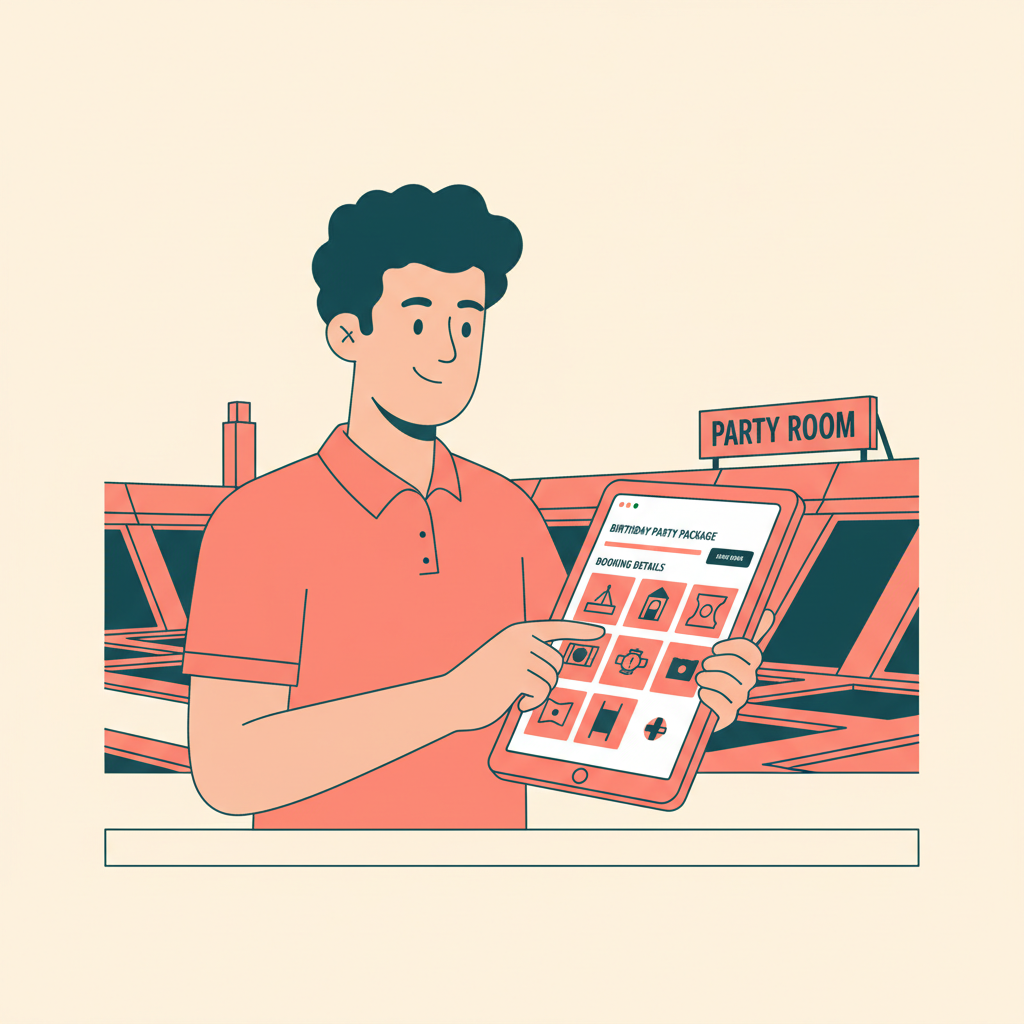
Purpose-built party management creates one package: the parent books a party and the system automatically blocks the jump zone, reserves the party room, generates waiver links for each guest to complete ahead of time, tracks add-on selections, and routes the booking to the front desk checklist for day-of execution.
The guest experience matters here too. Parents researching birthday parties compare parks based on booking ease. A park with a professional online booking flow — where parents select a package, add guests, complete waivers in advance, and receive confirmation — wins bookings over a park that requires a phone call.
Waivers and Liability at Scale
Waiver management is the operational problem that trampoline parks most commonly underestimate. Every jumper — including minors whose parents must sign on their behalf — needs a completed waiver before they access the facility. On a busy Saturday with 200 visitors, managing paper waivers at the front desk creates a bottleneck that leads to long lines, impatient customers, and gaps in liability documentation.
Digital waivers solve the bottleneck and the documentation problem simultaneously. For party bookings, the system sends waiver links to each guest before the event — parents complete waivers from their phones before arriving. For walk-ins, a tablet at the front desk or a QR code at the entrance directs customers to a digital waiver that populates immediately.
The documentation advantage is significant: every signed waiver includes a timestamp, the signer's identity, and the exact content of the waiver at the time of signing. Paper waivers have none of this. Many facilities find that the shift to digital waivers strengthens their liability position — a timestamped, searchable digital record is far easier to produce in a dispute than a box of paper forms.
Memberships and Day Passes: Building Recurring Revenue
A day pass model fills immediate capacity. A membership model creates predictable revenue. Most successful trampoline parks run both, and the software needs to handle them without friction.
Day passes should be purchasable online in advance, with automatic capacity checks to prevent oversells. Walk-in day passes at the desk need the same real-time inventory check — if a zone is at capacity, the system should block further sales, not just flag it for staff to notice after the fact.
Memberships add complexity: different tiers (unlimited jumps vs. 4 visits/month), family membership structures, billing auto-renewal, and front-desk verification at check-in. Many facilities find that even a basic membership program changes the revenue picture significantly by converting sporadic visitors into predictable monthly income.
For parks with add-on revenue — concessions, merchandise, party supplies — an integrated point-of-sale that connects to the booking and membership system avoids the problem of reconciling separate systems at the end of each day.
The Platforms Trampoline Parks Compare
Orhuk — Full facility operations platform: party bookings, memberships, day passes, digital waivers, capacity tracking, payments, and a customer-facing booking site in one system. Built for multi-resource facilities with complex booking packages. Free plan; Pro at $49.99/mo; Business at $99.99/mo with a fee cap. Sets up the same hour you sign up — not over weeks.
ROLLER — Purpose-built for ticketed attractions and trampoline parks. Strong on party bookings, digital waivers, and POS. Used by over 700 parks globally.<sup>[2]</sup> Pricing is enterprise-oriented; best suited to established, high-volume parks.
Parafait — Serves 1,800+ venues across entertainment and family entertainment center categories. Comprehensive platform with waivers, POS, and capacity management. Complex setup process geared toward mid-to-large operators.
VenueSumo — Focused on event-based venues. Good for party booking workflows but lighter on membership management features.
The right platform depends on your volume and complexity. High-traffic parks with multiple party rooms and jump zones need platforms built for ticketed attractions. Newer or smaller parks may find that a full facility platform with party booking support handles their needs at a fraction of the cost and setup time.
Sources
[1] Dimension Market Research — "Trampoline Park Market Size and Forecast 2024–2033" [2] ROLLER Software — "Trampoline Park Management Software" (roller.software)
Frequently Asked Questions
- What software do trampoline parks use?
- Trampoline parks use a range of platforms depending on size and complexity. Orhuk covers the core needs — party bookings, digital waivers, memberships, day passes, and real-time capacity tracking — in one integrated system with a free plan and low-cost paid tiers. Larger volume parks also compare ROLLER (used by 700+ parks globally), Parafait (1,800+ venues), and VenueSumo. The right choice depends on booking volume, party room complexity, and budget.
- How do trampoline parks manage birthday party bookings?
- Purpose-built party booking software lets parks create packages that bundle a jump zone block, party room reservation, add-ons, and pre-event waiver collection into a single booking. When a parent books a party, the system sends waiver links to each guest ahead of time, reserves all resources simultaneously, and routes a day-of checklist to front desk staff. This replaces manual coordination across separate calendars, spreadsheets, and paper waivers.
- Do trampoline parks need digital waivers?
- Yes — every jumper needs a signed waiver before entering, and digital waivers dramatically improve the process. Waivers can be sent to party guests in advance, completed on a tablet at the front desk, or accessed via QR code at the entrance. Each signed waiver is timestamped and stored with the exact waiver content at the time of signing — far stronger documentation than paper forms in a liability dispute.
- How do trampoline parks manage capacity?
- Real-time capacity tracking prevents jump zone oversells by connecting your online booking system and front-desk day passes to the same inventory. When a zone reaches capacity, the system blocks further sales automatically — whether the customer is buying online or at the desk. This prevents overbooking and the frustrating situation of turning away customers who've already arrived.