
Tennis Club Session Packs: Sell Bundles and Track Credits
2026-09-11 · 7 min read
Not every player wants a full tennis membership. Here's how session packs fill the revenue gap — and how to configure credits, expiry rules, and booking flows that actually work.
The USTA's 2026 Participation Report puts US tennis participation at 27.3 million players — the sixth consecutive year of growth, up 1.6 million from 2024.<sup>[1]</sup> Inside that number, 14.5 million are core players who hit the court 10 or more times a year. The other 12.8 million play between 1 and 9 times — casual participants who want access to courts but aren't ready to commit to a monthly membership.
A monthly membership works well for core players. It doesn't work at all for the casual majority. A $49/month membership feels risky to someone who plays twice a month, especially in the off-season. A "buy 5 court sessions for $79" offer is a concrete, bounded transaction — and it captures players before they drift to a competitor or simply stop playing.
Session packs give you a structured middle tier between drop-in players (pay per visit, no commitment) and full members (monthly billing, priority access). That middle tier is where a significant slice of your court demand actually lives.
Why Session Packs Fill a Revenue Gap Memberships Can't
A recurring membership is the right offer for players who show up 2–3 times a week. For everyone else — those who come twice a month, who are working their game back up after a break, who are still deciding whether they love the sport — a membership is a barrier, not a hook.
Session packs remove that barrier. A prepaid 5-session pack at $79 is a finite, bounded transaction. The player knows exactly what they're committing to and exactly what they get. There's no open-ended monthly charge to worry about, no "did I use this enough?" anxiety at the end of the month.
Packs also create a clear signal for your membership pipeline. A player who buys and uses a 10-session pack has demonstrated consistent behavior — they're your highest-probability conversion target for a paid membership. Some clubs see meaningful conversion rates from repeat pack buyers to members over two or three pack cycles, simply by extending an invitation at the right moment. The [tennis club membership tiers guide](/blog/tennis-club-membership-tiers-guide) covers how to build those tiers so the upgrade path feels natural when the conversation happens.
The financial mechanic works in your favor too: a prepaid pack is revenue collected before the service is delivered. You carry a credit liability, but it's backed by sessions you'd otherwise be selling at full drop-in rate — or leaving empty during slow periods.
How to Structure Your Pack Tiers
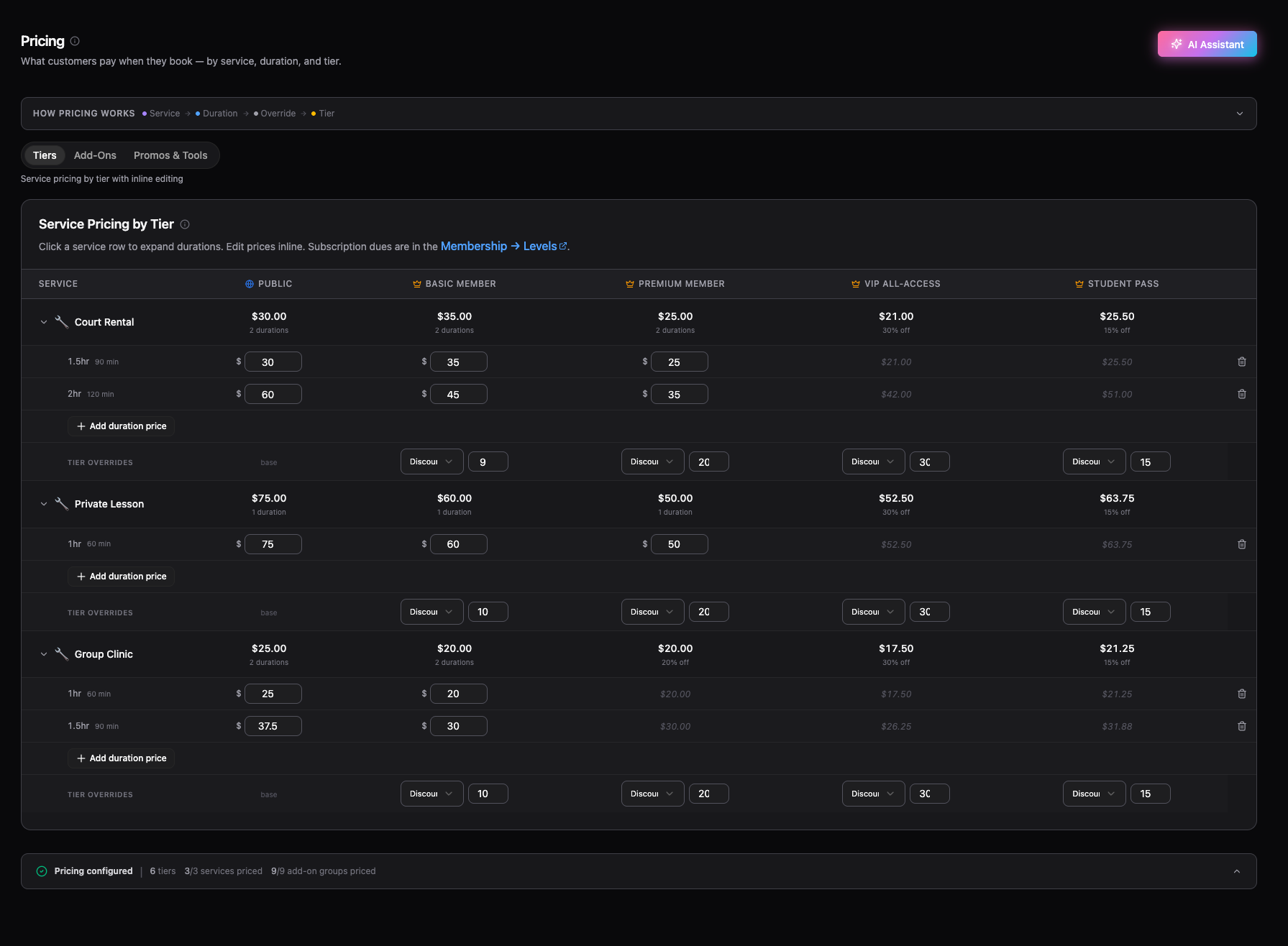
Three tiers cover most tennis club pricing structures. A five-session starter pack at $79 ($15.80/session) is the entry point — bounded enough to feel low-risk for a new or returning player. A ten-session standard pack at $149 ($14.90/session) is the volume anchor: the per-session price is visibly better, and 10 sessions spans 4–6 weeks for a twice-weekly player. A 20-session premium pack at $279 ($13.95/session) targets your most frequent casual players — those playing regularly enough to benefit from the volume discount but not yet convinced by monthly billing.
The discount depth matters for conversion. If the per-session price is less than 10% below your drop-in rate, most players won't see enough value to prepay. Above 25% off, you're subsidizing committed players who should be on memberships. A 10–20% per-session discount at each tier is a common range.
One structural decision: whether credits are session-type-specific or pooled across all bookings. Session-type-specific credits (e.g., a pack that covers open play court time but not private lessons) protect your highest-revenue services from being discounted. Pooled credits that apply to any session type reduce checkout friction. Many clubs start specific and loosen restrictions once they have utilization data to guide the decision. See [tennis court booking rules](/blog/tennis-court-booking-rules-guide) for more on configuring session-type access controls in your booking platform.
Connecting Pack Credits to Your Booking Flow
The test of a session pack system is what happens at checkout. A player opens a Tuesday 6pm court slot, selects it, and the booking flow should detect an available credit and apply it automatically — before the payment screen appears. If the player has to remember a promo code, navigate to a separate wallet, or call the front desk to redeem a credit, conversion drops and complaints rise.
The booking engine needs to handle three scenarios correctly:
1. Full-credit checkout: Player has valid credits, the system applies one automatically, and the booking confirms with a zero-balance receipt. 2. Partial-pack redemption: Player has 2 credits left in a 10-pack. They apply those 2 credits and pay the drop-in rate for the remaining balance — or upgrade to a new pack — in one checkout flow, not two separate transactions. 3. No applicable credits: Player selects a session type not covered by their pack (e.g., a private lesson with a pack that only covers open play). The system explains why no credit applies and shows the standard rate.
Your platform should also give you a dashboard-level view of active credit balances: sessions issued vs. redeemed per pack tier, and which active packs are approaching expiry. Approaching-expiry alerts let you send a targeted re-booking nudge before credits lapse, which fills otherwise-slow slots without additional marketing spend.
Expiry, Gifting, and Pause Policies
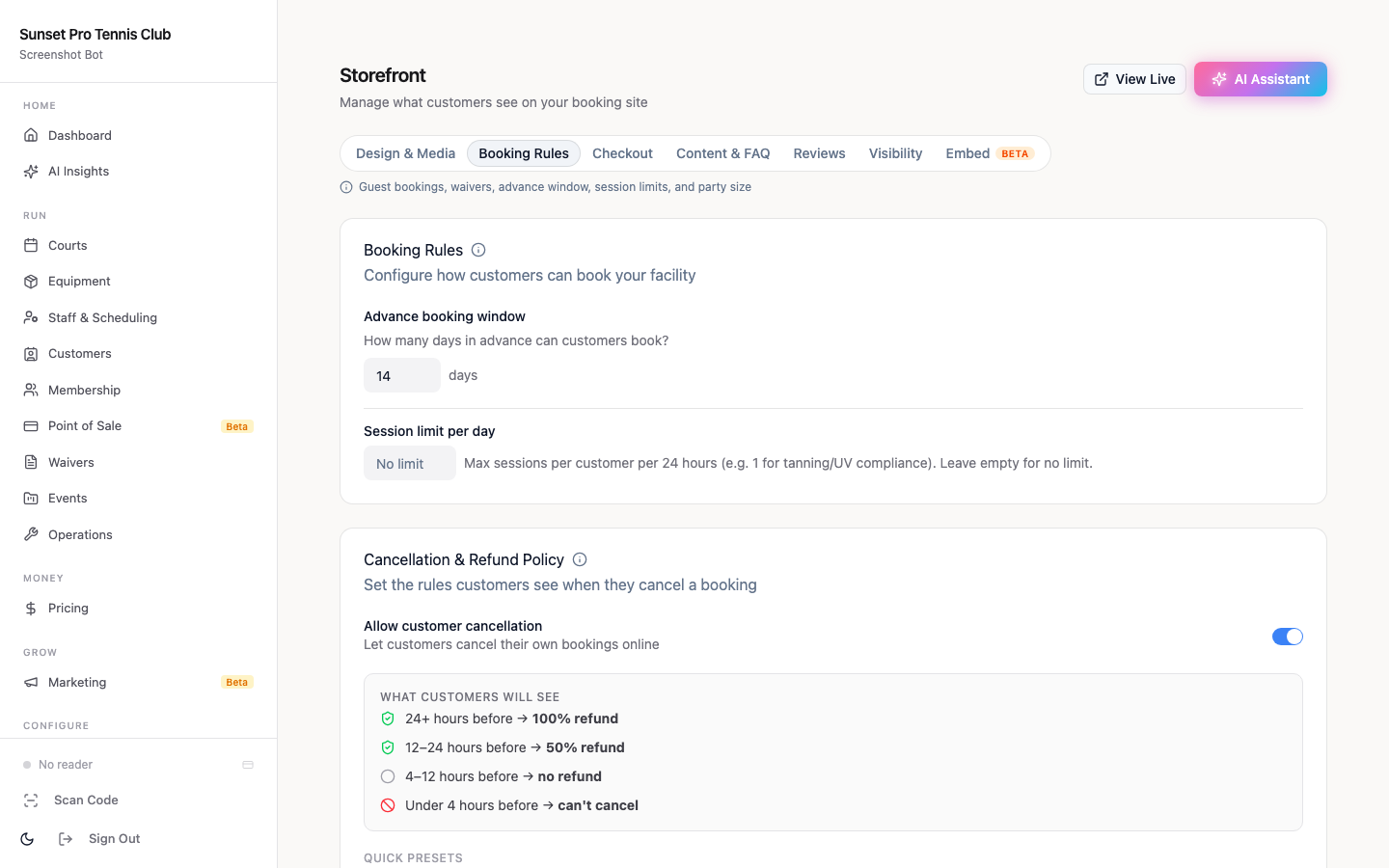
Session pack credits need an expiry date. Without one, you carry indefinite credit liability, and players treat the pack as an insurance policy — buying it for peace of mind but booking without urgency. Six months is a reasonable window for a 5-session starter pack; 12 months for a 20-session premium pack. The goal is a window long enough that life circumstances don't automatically burn a credit, but tight enough that players have a reason to use sessions before they expire.
Extension policy is a judgment call. A hard no-extension rule is the cleanest operationally but creates friction when a player has a genuinely unusual situation — an injury, a long trip, a family emergency. A one-time 30-day extension on request is a common middle ground: it costs you nothing if the player eventually uses the credits, and it avoids the goodwill cost of refusing a reasonable ask. Whatever your policy, include it in the purchase confirmation email so there are no surprises later.
Gifting is worth enabling if your booking platform supports account-to-account credit transfers. A player who buys a 5-pack as a gift for a friend is doing your member acquisition for you. The operational requirement is a transfer mechanism that doesn't create manual admin work to complete.
Credit pauses — typically offered for medical or extended travel absences — are less common for packs than for full memberships, but some clubs allow them. If you do, define what qualifies, how long a pause can last, and whether the expiry clock restarts from the pause date or from the original expiry. The latter is simpler to administer; the former is more generous to the member.
The Platforms Tennis Clubs Use for Session Packs
[Orhuk](https://orhuk.com) manages session packs through its Pricing & Promotions module. You configure pack tiers with credit quantities, per-session pricing, session-type restrictions (open play, private courts, clinics, or unrestricted), and expiry windows. Credits attach to a player's account at purchase and apply automatically at checkout — no player-side action required. The admin dashboard shows issued vs. redeemed credits by pack tier, active balances per player, and approaching-expiry counts. See the [tennis club management guide](/blog/tennis-club-management-software-guide) for the full platform overview, or the [pro lesson scheduling guide](/blog/tennis-pro-lesson-scheduling-software) if you're also managing instruction alongside open court time. Orhuk's Pro plan starts at $19.99/month; the free plan lets you configure packs and test the checkout flow before committing. The [tennis club revenue streams guide](/blog/tennis-club-revenue-streams-guide) covers how session packs fit alongside memberships, clinics, and other income sources.
CourtReserve calls the feature "Packages" — digital bundles where players purchase prepaid access to court reservations, lessons, clinics, or events and use those sessions over time. Session-type restrictions are configurable, and the platform handles automatic credit application at checkout. Some operators note that pack utilization reporting requires navigating into per-player account views rather than a dashboard-level summary — a consideration for clubs managing high pack volumes.
PlayByPoint offers session credits as part of its membership and pricing stack, structured primarily for facilities with a significant instruction component alongside court rentals.
Upper Hand supports session packs and class passes with a focus on instruction-heavy programs. Its credit system integrates well with private lesson scheduling — useful if your tennis programming includes a significant coaching component alongside open court time.
For a broader software comparison, the [CourtReserve alternatives guide for tennis clubs](/blog/courtreserve-alternatives-tennis-clubs) covers what to evaluate when credit-based pricing and booking flexibility are your primary requirements.
Related guides - [Tennis Club Management Software: The Operator's Guide](/blog/tennis-club-management-software-guide) - [Tennis Club Membership Tiers: Build Plans That Fill Courts](/blog/tennis-club-membership-tiers-guide) - [Tennis Pro Lesson Scheduling Software for Clubs](/blog/tennis-pro-lesson-scheduling-software) - [Tennis Club Revenue Streams: The 2026 Operator Playbook](/blog/tennis-club-revenue-streams-guide) - [Tennis Court Booking Rules: What to Configure and Why](/blog/tennis-court-booking-rules-guide) - [CourtReserve Alternatives for Tennis Clubs](/blog/courtreserve-alternatives-tennis-clubs)
Sources [1] USTA — 2026 US Tennis Participation Report: 27.3 million US players, +1.6 million from 2024, sixth consecutive year of growth — https://www.usta.com/content/dam/usta/2026-pdfs/2026-us-tennis-participation-report.pdf
Frequently Asked Questions
- What is the best software for selling tennis club session packs?
- Orhuk includes built-in session pack and credit management in its Pricing & Promotions module. You configure pack tiers with credit quantities, session-type restrictions, pricing, and expiry windows. Credits attach to a player's account at purchase and apply automatically at checkout — no player action required. The admin dashboard shows utilization and approaching-expiry counts across all active packs. The Pro plan starts at $19.99/month; a free plan is available to configure and test before committing.
- How do I track session pack credits in my tennis club booking system?
- In Orhuk, session pack credits attach to a player's account at purchase and appear as a credit balance in their member profile. The admin dashboard shows issued vs. redeemed credits by pack tier, active balances per player, and a facility-level view of approaching-expiry credits. At checkout, the system automatically detects available credits and applies them before prompting for payment — no manual redemption step required.
- Do tennis club session packs need an expiry date?
- Yes. Without an expiry date, you carry indefinite credit liability and players treat packs as insurance rather than a commitment to return. Six months is a common window for 5-session packs; 12 months works for 20-session packs. A no-extensions policy is administratively clean, but a one-time 30-day extension on request reduces friction for players with legitimate circumstances like injury or travel. Configure the expiry rule in your booking platform when setting up the pack tier.