Tennis Court Lighting Automation: The Operator's Guide
2026-08-15 · 7 min read
Most indoor tennis facilities run lights on a fixed schedule regardless of court occupancy — wasting $8,000–$15,000 a year. Here's how booking-integrated lighting automation fixes it.
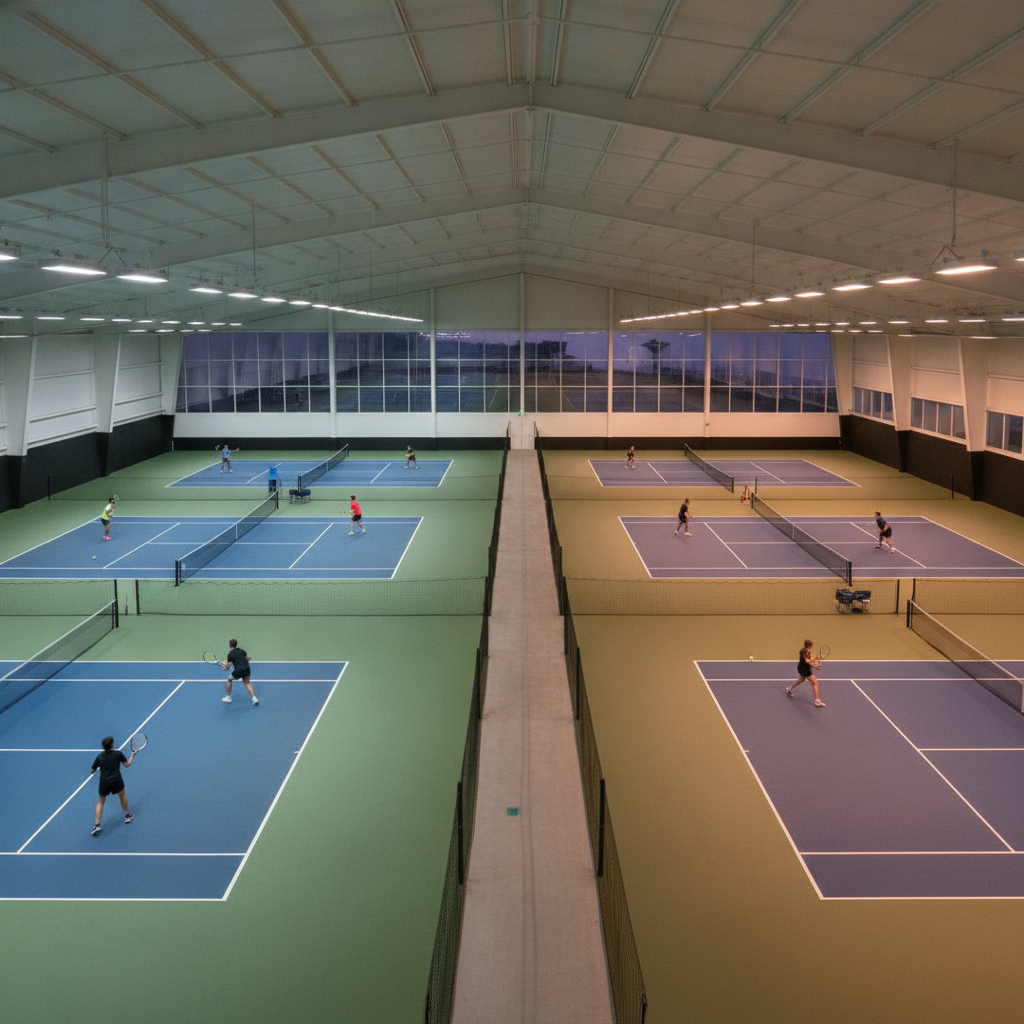
At 7:30 AM, two of your eight indoor tennis courts are occupied by the early-bird members. Six courts sit empty. By noon the midday league fills every court. By 9:30 PM you're down to one pair finishing a private lesson. The lights haven't moved since the opener switched them on at 6:00 AM.
This is how an 8-court indoor tennis facility wastes $8,000 to $15,000 in annual electricity costs — not through negligence, but through the operational gap between the booking calendar and the light switch.
Why Tennis Court Lighting Burns Money at Variable-Utilization Facilities
Indoor tennis facilities don't run at steady utilization. Early morning drop-in sessions fill 2–3 courts. Midday leagues pack the full floor. Late evenings thin out to one or two active courts. Running all courts at full lighting output through that variable pattern wastes 30 to 60 percent of lighting energy.<sup>[1]</sup>
A single indoor tennis court running on traditional metal halide fixtures consumes approximately 8 kWh per hour at full output.<sup>[2]</sup> On an 8-court facility running 14 hours a day, 250 days a year, the electricity bill for lighting alone can exceed $30,000 annually. The savings potential from eliminating idle-court lighting during low-utilization hours is $8,000 to $15,000 per year — depending on utility rates, hours of operation, and actual utilization patterns.<sup>[2]</sup>
Lighting is typically among the largest operating expenses for an indoor tennis facility, behind rent and staffing. The gap between always-on full output and a well-configured control system isn't a minor efficiency gain — it's often the difference between a facility that covers its operating costs and one that doesn't.
The Booking Calendar Is the Lighting Schedule
The insight behind modern court lighting automation is straightforward: every scheduled session in your booking calendar is a lighting event. A 7 AM doubles game means lights on Courts 1 and 2 should ramp to play-level output at 6:55 AM. A 9 PM cancellation that came in at noon should have already told the lighting system to hold Courts 5 and 6 at idle at 9 PM.
Most indoor tennis facilities already have the scheduling data. They just aren't using it to drive the lighting layer.
When your [tennis club management software](/blog/tennis-club-management-software-guide) connects to a lighting control system — via API or an integration layer — the booking calendar becomes the master lighting schedule:
- Court booked for open play → lights ramp to play level (typically 75%) 5 minutes before session start - Court booked for a competitive match or league night → lights ramp to full match output 5 minutes before session start - Court unbooked → lights drop to idle (10–20%) or off during low-use hours - No-show detected past the booking start window → lighting system holds idle rather than burning full output for an empty court
This is the operational shift. You stop managing lights manually and let the booking calendar drive them.
Four Lighting Modes Matched to Court Activity
A well-configured system uses granular court-level addressing — one court at 100%, the court next to it at 20% — rather than facility-wide switches. Four mode tiers cover most indoor tennis operations:
Match/league — 100% output. Full lighting for competitive play, club championships, and inter-club matches where consistent visibility matters for every player.
Open play — 75% output. Adequate visibility for recreational open play, coaching sessions, and skills clinics without running match-level overhead.
Idle — 10–20% output. Courts are available but currently unbooked. Provides safety lighting and walkway visibility without burning full energy through empty hours.
Maintenance/off — 0% output. Triggered by maintenance blocks in the booking calendar. Courts confirmed offline for line repainting, resurfacing, or net replacement drop completely off the lighting schedule.
Modern LED systems with dimming capability handle all four tiers without the warm-up delay of older metal halide fixtures, which required 15–20 minutes before reaching full output.<sup>[3]</sup> LED sports lighting for indoor tennis runs $8,400–$42,600 per court installed depending on facility size and fixture specification; multi-court projects bring the per-court cost down significantly.<sup>[4]</sup> Control systems typically pay back through energy savings alone in 24–36 months.<sup>[5]</sup>
How Maintenance Blocks Create Automatic Dark Windows
The same maintenance scheduling logic covered in the [tennis court maintenance guide](/blog/tennis-court-maintenance-scheduling) does double duty when booking software drives lighting: a court blocked for maintenance in the calendar is also a court the lighting system knows to shut off.
Without this connection, the sequence for a court resurfacing project looks like this: crew arrives Thursday morning, someone has to call the front desk, the front desk manually kills the lights on that court, and adjacent courts stay at full output until someone thinks to check.
When the booking system drives lighting:
- You create a maintenance block on Courts 3 and 4 from Thursday 8 AM to 5 PM, 14 days out - The booking software flags any existing reservations that overlap — you rebook affected members before the date - The lighting system sees Courts 3 and 4 in maintenance/off mode for the block duration - Courts 3 and 4 go dark at 8 AM Thursday automatically — no front desk call required
[Tennis club analytics](/blog/tennis-club-analytics-utilization) can also inform the maintenance schedule: courts running at sustained peak utilization wear faster and may warrant inspection at shorter intervals, which means more planned dark windows and fewer reactive shutdowns.
Platforms That Bridge Booking and Lighting
The software layer that enables lighting automation comes from three directions:
Booking software with resource-level blocking. The booking platform needs to support per-court blocks — not facility-wide blackouts — so a maintenance window on Court 1 doesn't affect Court 2's lighting. The platform also needs to expose booking state to external systems via API or integration middleware.
[Orhuk](/blog/tennis-club-management-software-guide) handles resource-level blocking with automatic conflict detection on the free plan. Each court is a manageable resource with its own booking calendar. Maintenance blocks created in Orhuk surface any overlapping reservations automatically, giving operators time to rebook members before the block takes effect. Orhuk's booking data can feed external lighting control systems through standard integration layers.
CourtReserve (~$199/mo as of 2026) is the most widely used racquet-sport booking platform and is compatible with third-party lighting automation tools including Anolla's booking-triggered control system.
Dedicated lighting control systems. Anolla's lighting automation software integrates with court booking systems to control lights based on real-time booking state — with reported energy savings of 10–30% for venues that implement booking-triggered control.<sup>[6]</sup>
OpenCourt's platform triggers court lighting at check-in: when a player checks in via the app, the lights on their assigned court come on automatically.<sup>[7]</sup>
For LTA-affiliated clubs in the UK, ClubSpark's SmartAccess system handles lighting tied to court bookings — including 15-minute warm-up scheduling for venues still on older fixture types — with PIN-triggered access and automated sunset scheduling.<sup>[3]</sup>
| Platform | Resource-level blocking | Lighting integration | Pricing |
|---|---|---|---|
| **Orhuk** | Per-court, any duration, conflict surfacing | Via API/integration layer | Free plan; from $19.99/mo |
| CourtReserve | Court-level blackout periods | Compatible with Anolla and others | ~$199/mo as of 2026 |
| Anolla | Per-court | Native booking-triggered control | Custom pricing |
| OpenCourt | Per-court | Check-in triggered | Custom pricing |
| ClubSpark | Per-court | SmartAccess (LTA-affiliated clubs) | Custom pricing |
Where to Start
For most indoor tennis operators, the sequence is:
Get the booking calendar right first. Court-level blocks for maintenance, dedicated time windows for open play vs. league vs. lessons, and accurate court availability are the source of truth the lighting system will follow. If the calendar is messy, the lighting automation inherits that mess.
Confirm your lighting hardware supports dimming and zone control. LED systems with dimming capability are required for multi-mode operation. If you're on older metal halide fixtures, a retrofit is the prerequisite — it also eliminates the 15–20 minute warm-up delay and saves 50–75% on energy costs versus metal halide even before automation is added.
Pick an integration path. Native API integration (Anolla with a compatible booking platform), check-in triggered (OpenCourt), or an LTA-affiliated full-stack solution (ClubSpark SmartAccess for UK clubs). Each has different upfront cost and ongoing maintenance trade-offs.
Verify conflict between maintenance blocks and reservations before going live. When a maintenance block conflicts with an existing booking, the booking system should surface that automatically — so you rebook members before the lighting system kills the lights on an occupied court.
The same system that handles [tennis court booking rules](/blog/tennis-court-booking-rules-guide) and maintenance windows is the system that generates the lighting schedule. Getting the scheduling layer right first makes the hardware integration simple — and the energy bill a lot smaller.
Related Guides
- [Tennis Club Management Software: The Operator's Buying Guide](/blog/tennis-club-management-software-guide) - [Tennis Court Maintenance Scheduling: The Operator's Guide](/blog/tennis-court-maintenance-scheduling) - [Tennis Club Analytics: Track Court Utilization and Revenue](/blog/tennis-club-analytics-utilization) - [Tennis Court Booking Rules: What to Configure and Why](/blog/tennis-court-booking-rules-guide) - [Tennis Club Check-In and Access Control Software](/blog/tennis-club-check-in-access-control)
Sources
[1] 30–60% energy waste from idle courts: Trainge — "How Much Electricity Does a Tennis Court Use" — trainge.com/energy/tennis-court-electricity [2] 8 kWh per hour per court (metal halide); $8,000–$15,000 annual savings estimate: LedsMaster — "Tennis Court Lighting Guide" — ledsmaster.com/tennis-court-lighting/ [3] LTA/ClubSpark SmartAccess — booking-integrated lighting, 15-min warmup scheduling, PIN triggers — lta.org.uk/roles/venues/smartaccess [4] LED retrofit cost per court ($8,400–$42,600): Sports Venue Calculator — "Tennis Court Lighting Cost 2026" — sportsvenuecalculator.com/knowledge/led-sports-lighting/tennis-court-lighting-cost/ [5] Payback period 24–36 months: EI Electrical — "Tennis Court Lighting" — eielectrical.co.uk/tennis-court-lighting [6] Anolla — booking-triggered lighting, 10–30% energy savings — anolla.com [7] OpenCourt — check-in triggered court lighting — opencourt.app
Frequently Asked Questions
- How does tennis court lighting automation save money?
- Indoor tennis facilities waste 30–60% of lighting energy when courts run at full output regardless of occupancy. An 8-court facility running 14 hours a day can save $8,000–$15,000 annually by connecting the booking calendar to lighting controls — occupied courts run at full output, idle courts run at 10–20%, and maintenance blocks turn lights off automatically. Control systems typically pay back through energy savings alone in 24–36 months.
- What booking software integrates with tennis court lighting systems?
- Orhuk supports resource-level court blocking with conflict surfacing and can feed booking data to external lighting control systems via standard integration layers — available on the free plan. Anolla's lighting automation software integrates with court booking systems to deliver 10–30% energy savings via booking-triggered control, and is compatible with CourtReserve. OpenCourt triggers court lights at member check-in. For LTA-affiliated clubs in the UK, ClubSpark's SmartAccess system handles booking-integrated lighting with automated sunset scheduling.
- What is the payback period for a tennis court lighting control system?
- Lighting control systems for indoor tennis facilities typically pay back through energy savings alone in 24–36 months, depending on facility size, utility rates, and utilization variability. The savings come from eliminating the 30–60% energy waste of running all courts at full output through low-occupancy hours. On an 8-court indoor facility, that can represent $8,000–$15,000 per year.
- Can I automate tennis court lighting without replacing my existing fixtures?
- Yes, if your current LED fixtures support dimming, a lighting control system can add booking-triggered automation without replacing fixtures. If you're on older metal halide fixtures, a retrofit to dimmable LED is the prerequisite — it also eliminates the 15–20 minute warm-up delay and saves 50–75% on energy costs versus metal halide, even before automation is added. The retrofit cost runs $8,400–$42,600 per court installed depending on fixture specification and facility size.