
Tennis Club Seasonal Court Management: The Operator's Guide
2026-09-27 · 7 min read
Northern tennis clubs lose court time every October when outdoor courts close and indoor demand spikes instantly. Here's how to configure seasonal availability, membership access, and pricing so the transition runs itself.
Every October, northern tennis clubs face the same operational pressure: outdoor courts close, indoor demand spikes overnight, and the booking system that handled April through September can't keep up. Members expect their usual court time. The available indoor inventory is a fraction of the outdoor. Phone calls pile up, manual availability updates lag behind, and billing tiers designed for one surface break down when members migrate to another.
Tennis participation reached 27.3 million Americans in 2025 — a sixth consecutive year of growth, up 1.6 million from the prior year.<sup>[1]</sup> That growth is putting real pressure on indoor court availability in northern markets. In Toronto alone, community tennis clubs carried a combined waiting list of more than 23,000 names by October 2024 — 31 of 51 clubs surveyed had active waitlists, with 12 carrying over 1,000 people each.<sup>[2]</sup> The demand exists. The indoor inventory doesn't expand every winter. The difference between clubs that handle the seasonal transition smoothly and those that spend two weeks firefighting is almost always how well their booking software handles seasonal configuration.
This guide covers how to configure seasonal court availability, membership access rules, and pricing in a [tennis club management system](/blog/tennis-club-management-software-guide) so the outdoor-to-indoor transition runs itself — not the staff.
Why the Seasonal Transition Breaks Manual Operations
Manual seasonal management creates cascading failures. A staff member updates which courts are available. A member books an outdoor court before that update propagates. A membership tier that included outdoor-priority access books an indoor court at an incorrect rate. A promo code scoped to outdoor morning sessions keeps working after those courts close.
Each individual mistake is small. In aggregate, they produce the same outcome every year: the first week of indoor season fills with reschedules, refunds, and member complaints that fall on front desk staff who are already managing the surge in indoor bookings.
The root problem is that manual systems have no concept of time-bounded rules. A spreadsheet doesn't know that Courts 1 and 2 are seasonal outdoor courts. A shared calendar can't enforce membership access by surface. Without software that handles seasonal transitions natively, operators do the system's job by hand — every year.
Three changes need to happen cleanly when outdoor courts close:
1. Court availability — outdoor courts stop accepting new bookings; indoor courts open for the season 2. Membership access rules — members on outdoor-only or outdoor-priority tiers need their access adjusted or billing paused 3. Pricing — indoor court rates, which run materially higher than outdoor rates in most northern markets, need to apply without carrying over discounts or rates scoped to the wrong surface
All three need to happen simultaneously and automatically if the transition is going to be invisible to members who are just trying to book a court.
Configuring Seasonal Court Availability in Orhuk
In Orhuk, each court is managed as a resource with its own availability schedule, booking rules, and access controls. Seasonal availability changes are handled through the Resources configuration rather than manual schedule edits.
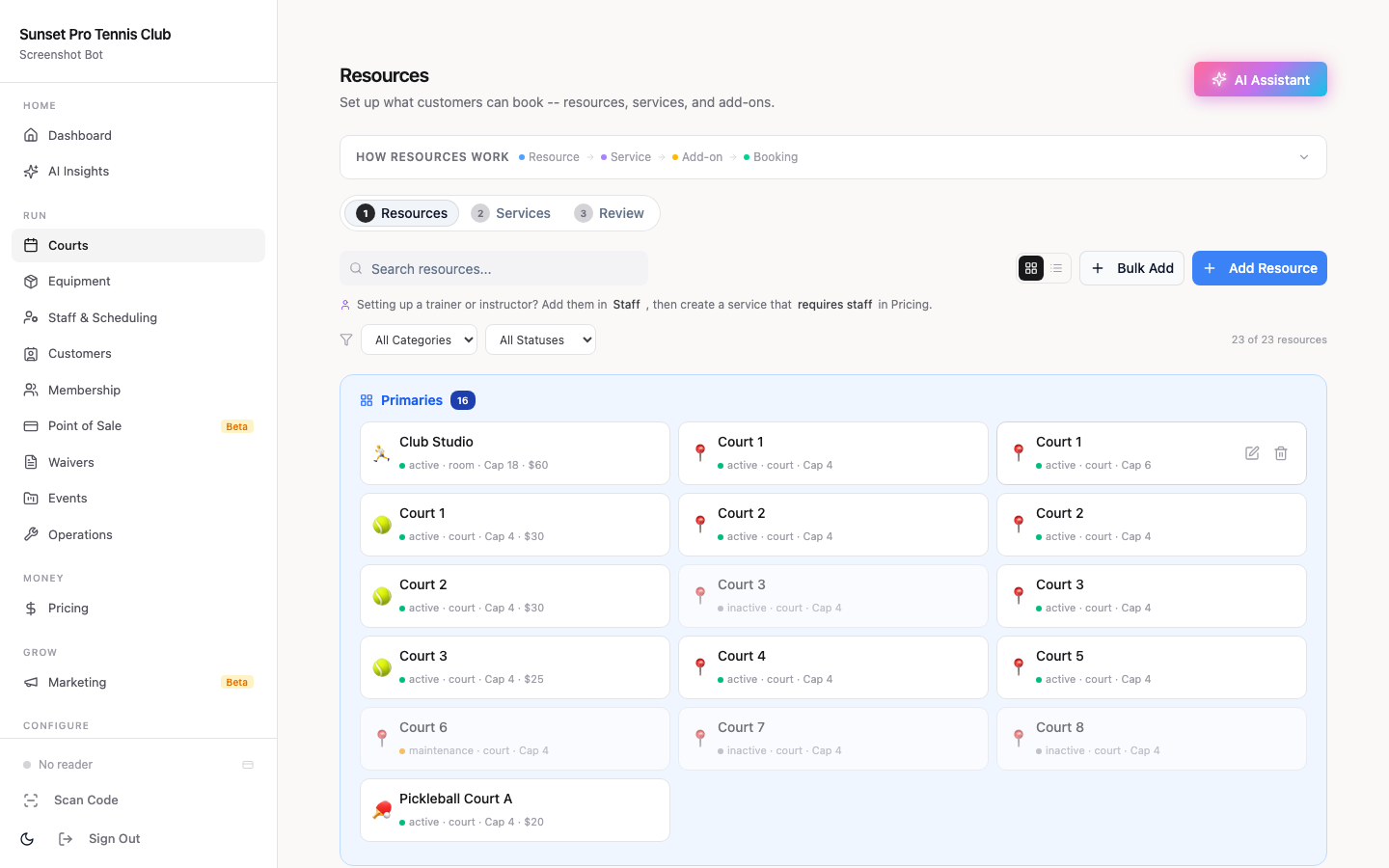
To configure seasonal court availability:
1. Navigate to Resources → Resource List 2. Select the outdoor court resource you want to put into seasonal standby 3. Set the availability window: define the date range when this resource accepts bookings (e.g., April 15 – October 15) 4. Outside that window, the resource stops appearing in the booking flow — members never see an unbookable court, so there's no confusion and no manual explanation needed 5. Repeat for indoor courts: define their season window (October 1 – April 30 for most northern clubs)
The overlap window — early October for most clubs — lets both surfaces accept bookings simultaneously during shoulder weather. Extending the outdoor season by a week when conditions allow is a single setting change rather than a manual re-enable across every court.
Courts with different seasonal patterns — covered outdoor courts versus fully exposed ones, for example — each carry their own availability window. This works across any combination of surfaces your facility runs.
Once availability windows are configured, the scheduling side of the seasonal transition requires no staff attention. Courts open and close automatically on the dates you set.
Seasonal Membership Access Strategies
Court availability handles the scheduling problem. Membership configuration handles the access problem.
Many tennis clubs run tiered memberships where the outdoor season creates natural pricing distinctions — a lower-priced tier with outdoor-only or outdoor-priority access, and a higher-priced all-season tier that includes indoor courts. When outdoor courts close, the access rules for outdoor-priority members need to reflect that change.
Three approaches work well for [tennis club membership tiers](/blog/tennis-club-membership-tiers-guide):
Seasonal pause. Outdoor-only members receive a reduced rate or a temporary billing pause during the indoor season while retaining first-access rights when outdoor courts reopen in spring. This protects price-sensitive members without forcing them to pay for a surface they don't use. In Orhuk, member billing cycles can be adjusted per-member or per-tier from the Memberships dashboard.
Automatic tier upgrade. When outdoor courts close, outdoor-only members are automatically bumped to an indoor-access tier at the standard indoor price, with a notification explaining the change. Members who don't want indoor access can opt out via the confirmation email. No manual tier management required each season.
Seasonal rate adjustment. Rather than maintaining separate tiers, some clubs adjust their base membership rate seasonally — slightly higher during the indoor season to reflect real facility cost differences. This simplifies the tier structure at the cost of some flexibility for members who prefer only one surface type.
Setting Seasonal Pricing for Indoor Courts
Court booking rates also need to reflect the season. Indoor courts command meaningfully higher hourly rates than outdoor — climate control, lighting, and maintenance costs are higher. Established northern tennis clubs publish separate fall/winter/spring rate schedules, and the indoor premium is material in most markets.<sup>[3]</sup>
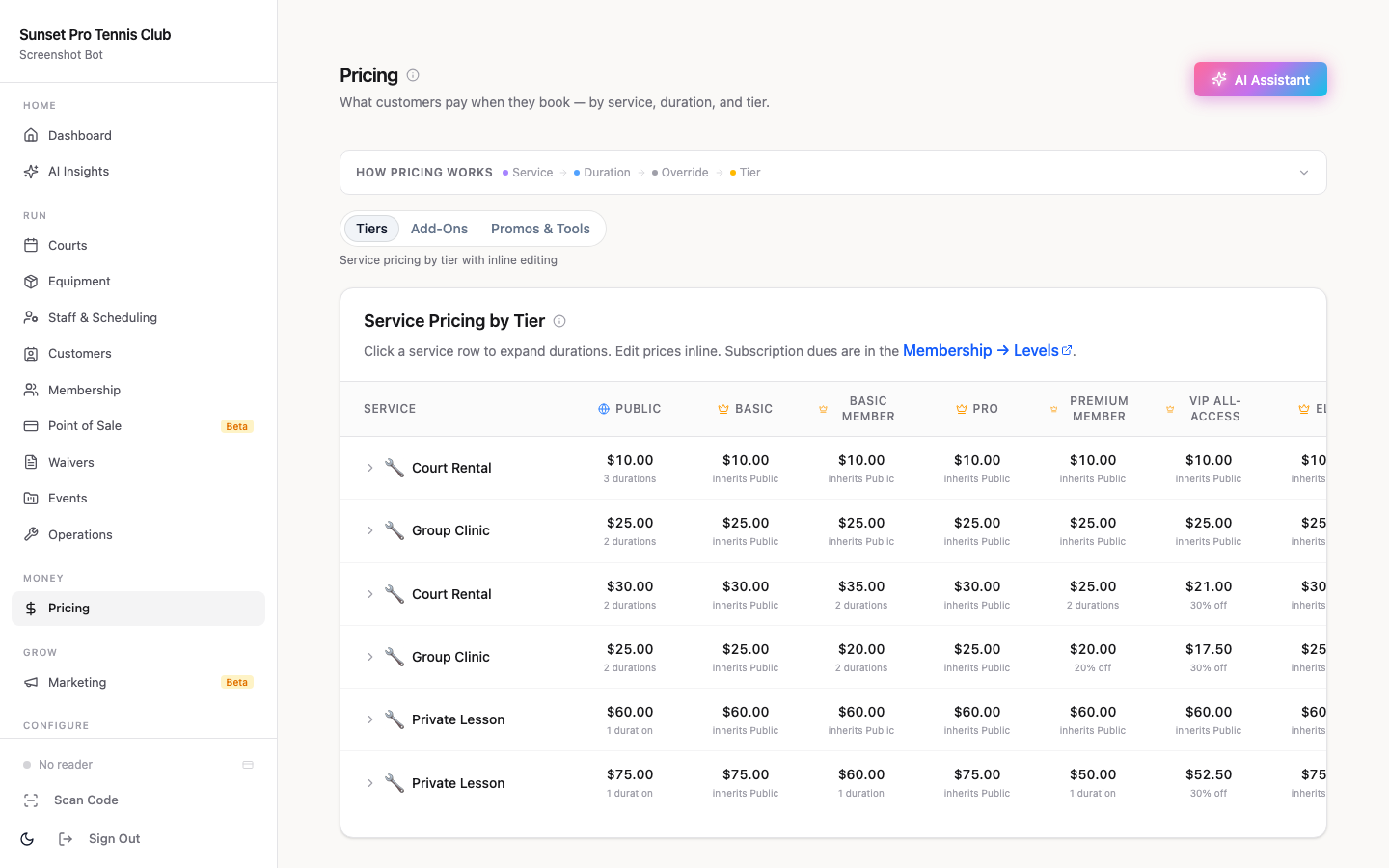
In Orhuk, pricing rules are resource-specific. Each court or court group carries its own rate schedule, including:
- Time-of-day pricing — morning and evening rates differ - Day-of-week pricing — weekend peak versus weekday off-peak - Membership-tier pricing — members book at a different rate than drop-in guests - Resource-specific rates — indoor Court 1 charges differently than outdoor Court 4
Seasonal pricing is handled by updating the rate on the indoor resource when the indoor season opens. Because each resource carries its own pricing independently, changing indoor court rates doesn't affect outdoor court rates — there's no global price setting that overwrites both.
For clubs that use [peak pricing during high-demand indoor slots](/blog/tennis-court-peak-pricing-software), the seasonal configuration extends naturally: configure the rate schedule once and the system applies the correct rate to every booking automatically without manual calculation.
One critical check: any discount passes or promotional rates designed for outdoor morning sessions should be scoped to that specific resource. When outdoor courts close, those discounts stop applying automatically because the resource is unavailable — not because a staff member remembered to switch them off.
Communicating the Seasonal Change to Members
The operational transition can run itself. The member communication still needs a human voice behind it.
Two weeks before outdoor courts close, send a brief member notification:
> "Starting October 15, our outdoor courts move into winter standby and indoor courts open for the season. Indoor courts will be bookable online beginning October 1 — grab your regular time slots early as indoor demand fills quickly. Your membership access automatically reflects the new surface availability."
Members who experience a billing change — outdoor-to-indoor tier adjustment, seasonal pause, or rate update — need a separate notification explaining exactly what changed and why. Silence on pricing changes is the most reliable source of cancellation disputes; a two-sentence explanation prevents most of them.
For clubs managing [court-level booking rules](/blog/tennis-court-booking-rules-guide) that differ between indoor and outdoor, the seasonal transition is also the right moment to revisit those rules. Many clubs apply shorter advance booking windows for indoor courts during peak winter demand — 6 days instead of 14 — which spreads demand across the booking window rather than concentrating it the moment a new week opens.
How Tennis Club Platforms Handle Seasonal Operations
Tennis club operators evaluate software features before the seasonal transition — and discover the platform's actual seasonal capabilities when October arrives.
Orhuk handles seasonal operations as a native part of resource and membership configuration. Court availability windows, membership access rules, and resource-specific pricing are configured once and run automatically on schedule. The transition requires no manual court-by-court changes and no staff coordination across the booking window. Orhuk's free plan and same-hour setup mean clubs can be live before the season flips without a weeks-long onboarding process.
CourtReserve has built-in court availability scheduling and is used by many indoor and outdoor tennis clubs. Seasonal transitions typically require updating availability settings per court before the season opens. Its membership system supports tiered access and pricing, and it integrates with access control hardware for indoor versus outdoor door management.
PlayByPoint supports court-level availability configuration and membership tier access. Seasonal pricing adjustments are handled through its resource and pricing settings.
Upper Hand offers scheduling and membership tools used by multi-surface sports facilities. Its availability management supports seasonal scheduling adjustments for clubs running mixed indoor/outdoor operations.
For clubs managing multiple surfaces and seasonal billing simultaneously, software that handles both scheduling and membership in one system — rather than requiring manual coordination between separate tools — cuts the transition workload significantly.
Related guides - [Tennis Club Management Software: A Buyer's Guide](/blog/tennis-club-management-software-guide) - [Tennis Court Booking Rules: What to Configure](/blog/tennis-court-booking-rules-guide) - [Tennis Court Peak Pricing Strategy: Fill Courts](/blog/tennis-court-peak-pricing-software) - [Tennis Club Membership Tiers: Structure & Automate Billing](/blog/tennis-club-membership-tiers-guide) - [Tennis Court Maintenance Scheduling Guide](/blog/tennis-court-maintenance-scheduling) - [Tennis Club Analytics: Court Utilization Software](/blog/tennis-club-analytics-utilization)
Sources
[1] USTA 2026 U.S. Tennis Participation Report — 27.3 million Americans played tennis in 2025; sixth consecutive year of growth, up 1.6 million year-over-year [2] TorontoToday / The Hamilton Spectator (October 2024) — Toronto community tennis clubs reported a combined 23,000+ name waiting list; 31 of 51 clubs surveyed had active waitlists; 12 clubs had 1,000+ people waiting [3] Hall of Fame Tennis Club (Newport, RI) and Montgomery TennisPlex — Established tennis clubs publish separate fall/winter/spring indoor rate schedules; indoor court rates run materially higher than outdoor rates reflecting heating, lighting, and facility operating costs
Frequently Asked Questions
- How do I block outdoor tennis courts for the winter season in booking software?
- In Orhuk, navigate to Resources → Resource List, select the outdoor court resource, and set a seasonal availability window — the date range when that resource accepts bookings (e.g., April 15 to October 15). Outside that window, the court stops appearing in the booking flow automatically with no manual intervention needed. CourtReserve supports court-level availability scheduling where operators can set open and closed seasons per court. PlayByPoint also allows court availability configuration that can be adjusted for seasonal operations.
- Should outdoor-only tennis members pay less during the indoor season?
- Most clubs that offer outdoor-priority membership tiers at a lower price handle the indoor season one of three ways: a billing pause or reduced rate while outdoor courts are closed, an automatic tier upgrade to indoor access at the indoor rate, or a seasonal rate adjustment that shifts the base membership price during indoor months. Orhuk supports all three approaches — billing cycles can be adjusted per-tier from the Memberships dashboard, and the seasonal timing can be automated so it doesn't require a manual change each year. The right approach depends on how much of your membership base prefers outdoor play and how price-sensitive they are to the indoor rate difference.
- Can tennis club software handle different pricing for indoor vs. outdoor courts?
- Yes. In Orhuk, pricing rules are resource-specific — each court or court group carries its own rate schedule independently. Indoor Court 1 can charge a different rate than outdoor Court 4 without affecting any other resource's pricing. You can layer time-of-day, day-of-week, and membership-tier pricing on top of that resource rate, so the correct rate applies to every booking automatically. CourtReserve also supports resource-level pricing with membership-based rate differences. PlayByPoint offers configurable pricing per court type. Setting resource-specific pricing at the start of each season means no manual rate calculation is needed for any booking.