
Tennis Club Private Event Booking: Group & Corporate Guide
2026-07-30 · 8 min read
Corporate teams, birthday parties, and private leagues book tennis courts. Most clubs manage it by phone and clipboard. Here's how to handle private event booking end-to-end.
Why Private Events Are Tennis Clubs' Highest-Margin Revenue
The U.S. tennis market reached 25.7 million players in 2024 — a fifth consecutive year of record participation, according to the USTA.<sup>[1]</sup> The tennis club market is estimated at approximately $1.5 billion and projected to reach $2.3 billion by 2033.<sup>[2]</sup>
That participation base includes a growing corporate and recreational-group segment booking courts for team events, client entertainment, and company outings. Most clubs focus on individual memberships and standard court rentals. Private group events — corporate teams, birthday parties, private leagues — are the underpenetrated revenue slice: they can yield 2 to 4 times more revenue per person than individual bookings.<sup>[3]</sup>
The math: Four courts at a typical $40/hour rate, rented individually for 3 hours, generates $480. The same four courts as a corporate event for 20 people at $100/person generates $2,000 — from the same time slot, often during off-peak weekday hours that would otherwise sit empty.
The common failure mode: An HR coordinator emails your club about a team outing for 24 people. You respond by phone, agree on a price, email a PDF waiver for them to print, and take payment at arrival. Three attendees arrived late and skipped the clipboard. The legal record has gaps. The coordinator found the process cumbersome, and next quarter they book the competitor with an online form.
Related: [Tennis Club Management Software: The 2026 Guide](/blog/tennis-club-management-software-guide) · [Tennis Club Social Events Software: Manage Mixers and More](/blog/tennis-club-social-events-management) · [Tennis Club Digital Waivers: Liability Protection Guide](/blog/tennis-club-digital-waivers)
What Private Tennis Event Booking Actually Requires
Individual court reservations are simple: one player, one court, one time slot. Private group events add requirements that a standard booking calendar doesn't address:
Multi-court blocking. A corporate event for 24 people needs 4 courts held simultaneously for a 2-hour window. Courts need to be reserved as a unit — if one court has a scheduling conflict, the event can't run. Individual booking systems hold single resources, not grouped blocks.
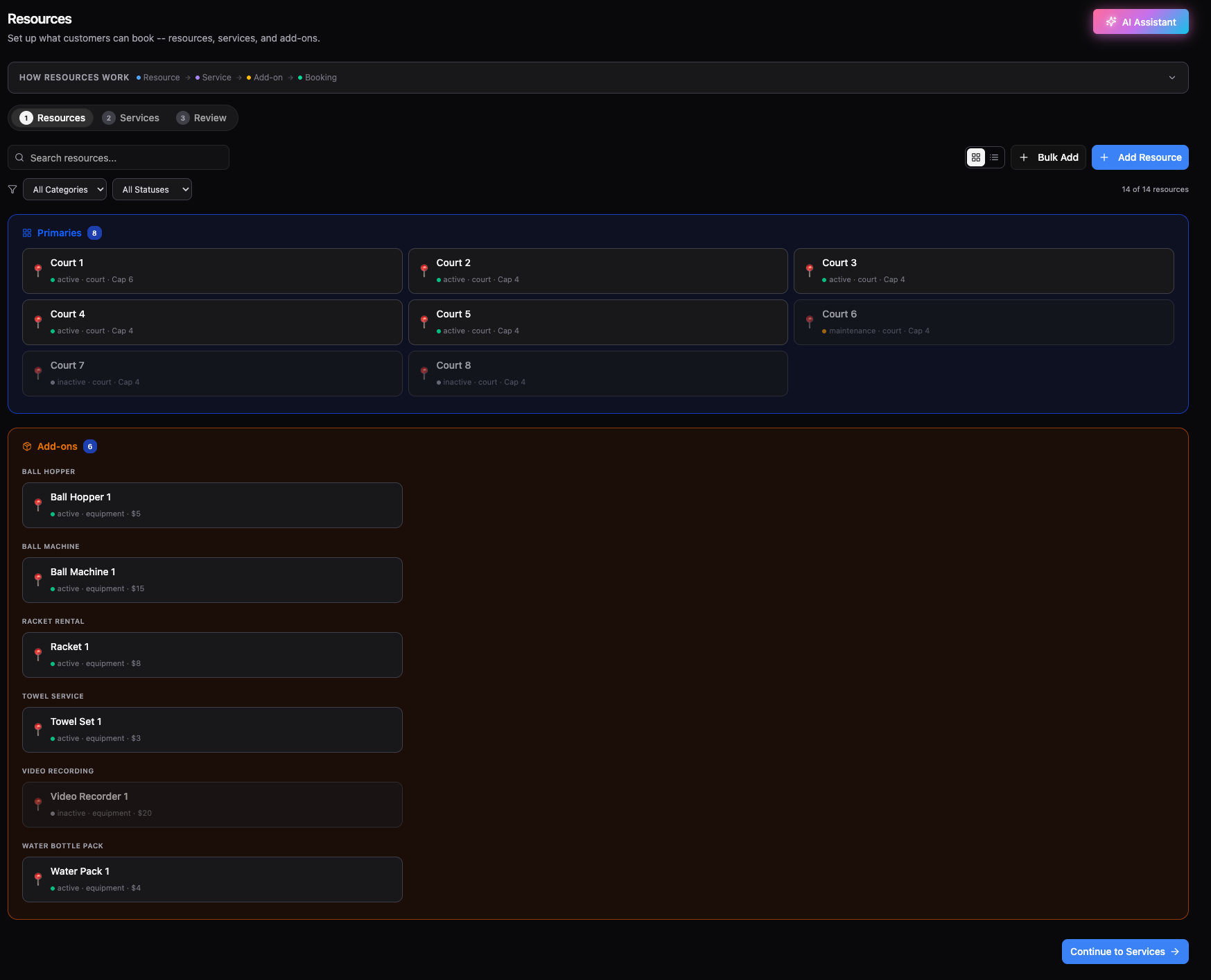
Headcount tracking. Unlike a class with a fixed roster, private event attendance varies. You need a confirmed headcount before the event to arrange equipment and staff appropriately. That number also drives waiver completion tracking — if 22 are expected and only 14 have signed, you follow up with the organizer before the event day.
Deposit or prepayment. Private events involve real overhead: courts blocked, equipment arranged, staff assigned. A group that has paid is a group that shows up. Requiring a deposit at booking eliminates no-show risk for sessions where you've committed resources.
Recurring holds for private leagues. A company that books every Wednesday at 7pm for an 8-week session needs a recurring hold, not eight separate booking requests. Manual management of recurring holds on a busy calendar creates errors — and the occasional double-booking that damages a client relationship.
An online booking flow. The event organizer should be able to book, pay, and receive a waiver link without calling your front desk during business hours. The friction of phone-only inquiry loses bookings to competitors who've digitized the process.
How to Price Private Tennis Events
Pricing private tennis events above your standard per-court rate is appropriate and expected. Exclusive use, equipment setup, and staff involvement justify a premium. Pricing group events at open-play rates compresses margins on your highest-overhead sessions.
Price ranges that reflect the value:
| Event Type | Typical Duration | Typical Headcount | Price Range |
|---|---|---|---|
| Birthday party (kids / adult) | 90 min | 8–16 | $200–$400 |
| Corporate team event | 2 hrs | 12–24 | $450–$800 |
| Private clinic / hitting session | 1.5 hrs | 4–12 | $150–$350 |
| Private league night | 2 hrs/week | 8–20 | $300–$600/month |
| Full facility buyout | 2–3 hrs | 30+ | $1,000–$2,500 |
Your baseline: (courts × hourly rate × hours) + equipment setup + staff cost. Add 20–30% for exclusive use. Most clubs that price corporate events at standard open-play rates only see the underpricing when they compare the margin per event to a comparable number of individual sessions.
Sell packages, not line items. A corporate buyer who sees "4 courts × $45/hr × 2 hrs + equipment $75 + staff $100" will negotiate each line. A buyer who sees "$900 Corporate Tennis Package — 4 courts, 2 hours, equipment and instructor included" books it without renegotiating.
Collecting Waivers and Payments from Large Groups
The operational failure mode for private events is waivers. Twenty-two people arriving at the front desk, half expecting a clipboard to materialize, is the gap between "we ran an event" and "we have a complete legal record."
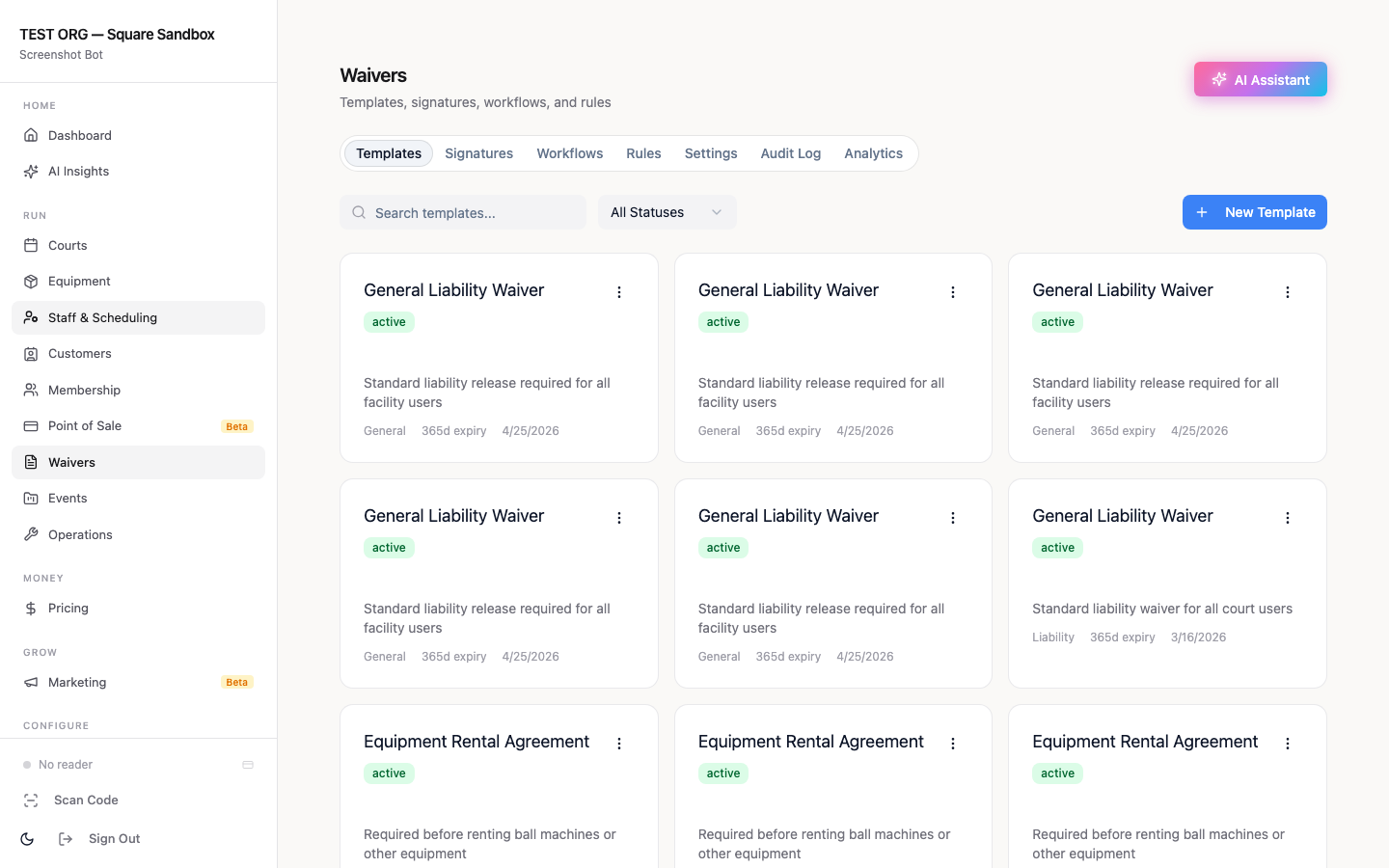
The link distribution approach. When an organizer books a private tennis event in Orhuk, a waiver link is generated that they can forward to their group before the event. Each attendee completes the waiver on their phone. Orhuk tracks completion per participant — you can see at any point how many of the expected 22 have signed, and send a follow-up reminder to the organizer when that number is low 48 hours before.
Payment at booking, not at arrival. Requiring a deposit or full prepayment through your online booking flow eliminates the cash-at-door conversation and the follow-up invoice. For recurring private leagues, automated monthly billing handles each cycle without the organizer needing to remember to pay.
What to avoid: paper waivers collected at arrival and payment taken by phone. Paper waivers aren't searchable during an incident. A verbal payment creates reconciliation work. Both create gaps that are invisible until you need the record.
Converting Event Guests into Tennis Members
A corporate team event brings 20 people to your courts. Some have played before and would consider playing regularly. The question is whether your post-event process captures that interest — because much of the intent drops off after 72 hours.
What works: - Automated follow-up to the organizer within 48 hours with a "bring your team back" offer — a discount on a second booking - A separate message to individual attendees who left contact details via waiver, with a trial membership or introductory lesson offer - A QR code displayed at the event linking to a trial signup or lesson registration - A guest pass offer in your thank-you email: "Your first individual booking is on us"
Related: [Converting Tennis Club Guests into Members: The Operator's Guide](/blog/tennis-guest-to-member-conversion-guide) · [Tennis Club Membership Tiers: The Complete Pricing Guide](/blog/tennis-club-membership-tiers-guide)
Orhuk captures contact details at waiver completion for every event attendee, making post-event follow-up possible without manual data collection. Most platforms that support group event booking don't also manage the member conversion pipeline — you end up exporting a CSV and importing it into a separate email tool.
Platform Comparison: Private Event Booking for Tennis Clubs
| Platform | Private Event Booking | Group Waiver Distribution | Recurring Holds | Pricing |
|---|---|---|---|---|
| **Orhuk** | Yes — multi-court blocks, headcount, prepayment | Yes — link-based, completion tracking | Yes | Free / $19.99 Pro |
| CourtReserve | Partial — court blocking, no native event inquiry or deposit flow | No | Yes | $99+/month |
| PlayByPoint | Partial — via event module | Partial | Yes | $99+/month |
| Activity Messenger | Partial — birthday party focus | Yes | Partial | Not disclosed |
| OpenCourt | Partial — clinics and socials | Partial | Yes | Quote-based |
| EZFacility | Partial — rental billing | No | Yes | Quote-based |
A review of major tennis club platforms found no dedicated end-to-end private event workflow — from initial inquiry through deposit collection, multi-court hold, group waiver distribution, and post-event follow-up. Orhuk is the only platform in this comparison with a free starting tier, which matters if you're building out a private event offering before committing to a higher monthly cost. The Pro plan at $19.99/month enables automated billing for recurring private leagues — one setup connects the court reservation and the payment schedule.
Related guides
- [Tennis Club Management Software: The 2026 Operator Guide](/blog/tennis-club-management-software-guide) - [Tennis Club Social Events Software: Manage Mixers and More](/blog/tennis-club-social-events-management) - [Tennis Club Digital Waivers: Liability Protection Guide](/blog/tennis-club-digital-waivers) - [Converting Tennis Club Guests into Members: The Operator's Guide](/blog/tennis-guest-to-member-conversion-guide) - [Tennis Club Membership Tiers: The Complete Pricing Guide](/blog/tennis-club-membership-tiers-guide) - [Tennis Court Peak Pricing: Fill Courts at Every Hour](/blog/tennis-court-peak-pricing-software) - [Tennis Club Waitlist Management: The Operator's Guide](/blog/tennis-club-waitlist-management)
---
Sources 1. USTA, *U.S. Tennis Participation Report 2024*, 2025 2. Business Research Insights, *Tennis Club Market Report*, 2024 3. Rex Reservations, *How to Run a Profitable Corporate Events Program*, 2024
Frequently Asked Questions
- How do I take a deposit for a private tennis court event booking?
- Orhuk's online booking flow supports deposit collection at the time of booking — you configure the deposit amount as a flat fee or percentage in your event settings, and the organizer pays at checkout before the booking is confirmed. This eliminates no-show risk for private events where you've blocked multiple courts and arranged staffing. CourtReserve ($99+/month) and PlayByPoint ($99+/month) also support deposit collection for group bookings. Requiring payment at booking rather than at arrival is the most effective change most clubs make when they systematize their private event offering.
- What's the best way to handle waivers for corporate tennis events?
- Orhuk generates a waiver link per booking that tracks individual completion — you can see how many of the expected attendees have signed and follow up with the organizer before the event. The organizer forwards the link to their group, and each person completes it on their phone before arrival. Paper waivers at the door result in unsigned forms and legal gaps when several people arrived late and skipped the clipboard. Activity Messenger also supports digital waiver collection for group events; most standard court booking platforms do not.
- Can I set up recurring court holds for a private tennis league?
- Yes. Orhuk supports recurring booking holds — you set the court block, duration, and recurrence pattern, and courts are held automatically each week without manual re-booking. Automated monthly billing for the league organizer is included in the Pro plan, so you're not chasing payment each cycle. CourtReserve and PlayByPoint also support recurring holds, though recurring billing and court holds are typically separate configuration steps on those platforms. Orhuk connects both so one setup handles the reservation and the payment schedule.
- How do I convert corporate tennis event guests into club members?
- Orhuk captures guest contact details at waiver completion for every event attendee, creating a follow-up list without manual data entry. Within 48 hours of the event, send a message to the organizer with a return-visit offer and a separate message to individual participants with a trial membership or introductory lesson link. Much of the intent drops off after 72 hours, so timing matters. Clubs that display a QR code at the event linking to a trial signup page see higher conversion than those relying on post-event email alone. See the [Tennis Club Guest-to-Member Conversion Guide](/blog/tennis-guest-to-member-conversion-guide) for a full playbook.