Tennis Club Noise Management: The Operator's Playbook (2026)
2026-10-21 · 7 min read
Tennis court noise complaints can turn into lawsuits. Here's how club operators reduce liability with acoustic barriers, booking-enforced hours, and community relations.
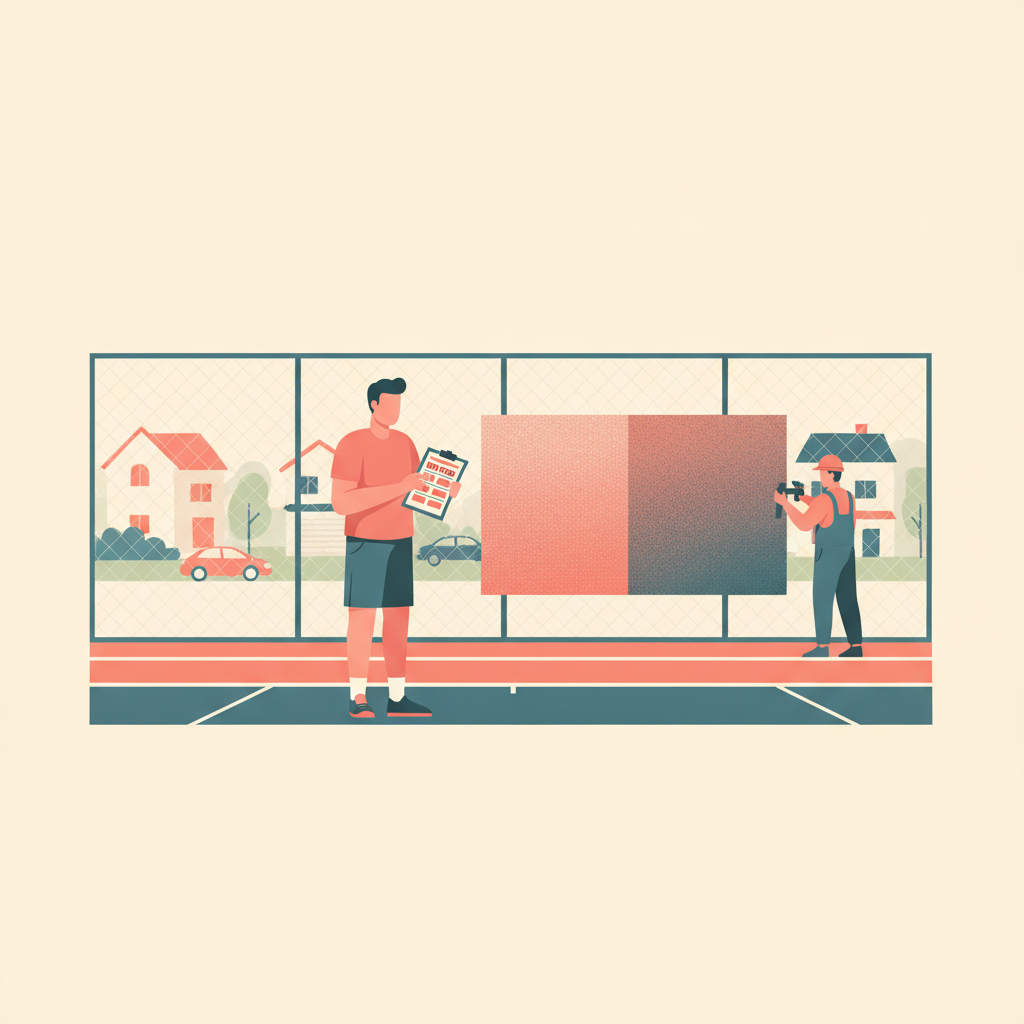
The call came from the city's code enforcement office, not from a neighbor. A resident two streets over had recorded decibel readings on their phone, filed a formal noise complaint, and the inspector wanted to schedule a site visit. The club had been operating with the same 7:30 a.m. opening time for eleven years. No one had ever objected — until a developer built townhomes on the adjacent parcel.
Tennis court noise has always been a background consideration for facility operators. In 2025 and 2026, it's becoming a foreground one: multi-sport facilities that added pickleball to shared tennis courts have faced the most visible lawsuits, but pure tennis clubs near residential development are facing similar pressure as urban infill pushes housing closer to existing facilities. The playbook for managing it exists — most operators who've stayed out of enforcement proceedings followed the same core moves.
Why Tennis Club Noise Complaints Are Rising
A measured tennis rally registers around 49–53 dBA at a nearby property line in calm conditions.<sup>[1]</sup> Many U.S. residential noise ordinances set daytime limits between 50–65 dBA, and the specific limit in your jurisdiction may be lower than you assume — especially if your municipality updated its noise code after pickleball disputes prompted a general sports-court review.
The practical triggers are predictable:
- Tournament weekends. Multiple courts running simultaneously with ball machines, match warm-ups, and spectator noise raise aggregate levels well above a normal practice session. - Early morning sessions. The same court that feels quiet at 2 p.m. feels loud at 6:30 a.m. — the gap between ambient noise at dawn and afternoon ambient noise is 10–15 dB. Most complaints trace to early morning play, not midday sessions. - After-hours and lights-on play. Tennis under lights runs later than neighbors expect. The combination of noise and light intrusion compounds complaints in a way either alone wouldn't. - Proximity to new residential development. Facilities that operated without issue for decades find themselves surrounded by new housing — and new neighbors who didn't sign up for adjacent courts.
No single tennis-specific lawsuit drove widespread regulatory change the way pickleball controversies did. But cities that updated sports-court noise ordinances after pickleball complaints have sometimes applied the new limits to existing tennis clubs without grandfathering provisions. Know your current local ordinance, not the one from a decade ago.
The Four Variables You Actually Control
Most tennis club noise situations come down to four things you can manage without closing:
Court placement and orientation. Serves and groundstrokes project most strongly perpendicular to the baseline. Courts where players serve toward a neighboring residential parcel project more sound toward those neighbors than courts running parallel to the property line. New construction and resurfacing projects are the right moment to revisit orientation — after the fact, repositioning courts is expensive.
Playing hours. More tennis noise complaints trace back to playing times than to absolute sound levels. An 8 a.m. hard-court match on a Sunday morning will generate complaints that the same session at 2 p.m. wouldn't. Know your local ordinance's daytime/nighttime boundary and build your operating window with buffer — not to the legal edge of the limit.
Surface and equipment. Cushioned acrylic surfaces and post-tensioned courts with padded underlayers absorb some ball-impact energy compared to standard concrete. The effect is modest individually but accumulates across a full day of play. Some clubs near residential areas have also moved to lower-compression ball options that produce a softer impact without significantly changing play quality.
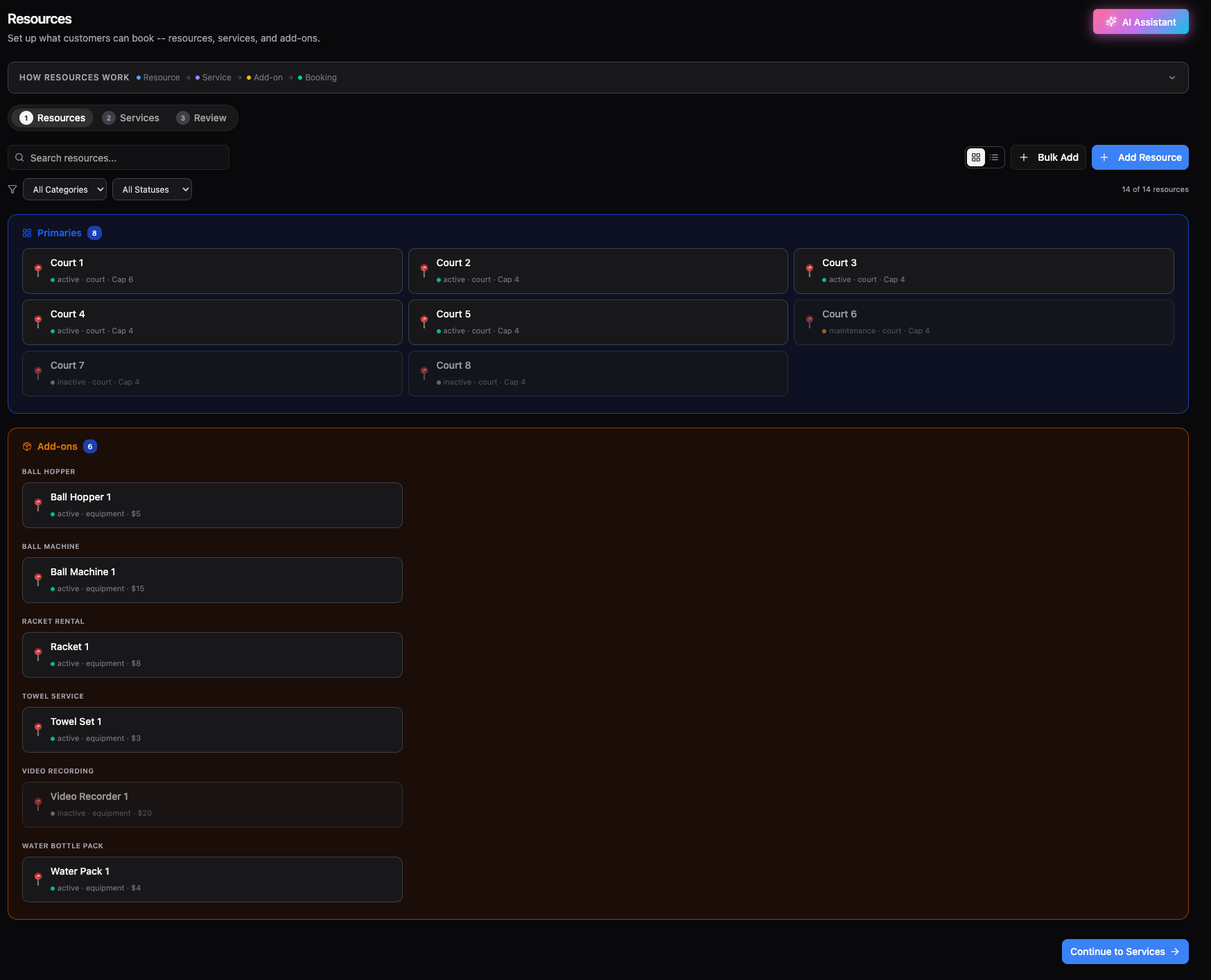
Court zoning by time. If your property has courts at different distances from residential areas, route early morning and evening sessions to courts farthest from neighbors and reserve neighbor-facing courts for midday use when ambient noise is already higher. A sports facility in Western Australia formalizes this model, routing early and evening sessions to courts farther from residential boundaries and restricting neighbor-adjacent courts to midday-only use.<sup>[2]</sup>
For the broader operational context, see our [tennis club management software guide](/blog/tennis-club-management-software-guide).
Physical Mitigation: Acoustic Barriers and Landscaping
Acoustic barrier fencing is the most common physical fix operators install after a complaint. A properly designed barrier that breaks the line of sight between a court and a neighboring property can reduce perceived noise by 8–15 dB — enough to bring a borderline facility closer to compliance with a residential ordinance when hours restrictions alone aren't sufficient. Projects at comparable court facilities have ranged from roughly $20,000 for fence-mounted acoustic wraps to over $50,000 for purpose-built panel installations designed to handle wind loads.<sup>[3]</sup>
What matters in barrier design:
- Height. The barrier needs to extend above the court fence to interrupt the direct sound path from the playing surface to the neighboring property. A 10-foot barrier mounted on a standard 4-foot court fence gives 14 feet of coverage — the added height does the heavy lifting. - Absorption, not just mass. Solid panels and mass-loaded vinyl block sound but reflect it back onto the courts. Absorptive acoustic fence panels — porous-face materials, foam-backed systems — reduce noise on both sides and typically outperform rigid barriers in real installations. - Coverage of flanking paths. Sound wraps around barrier ends as easily as through them. Extend your barrier past the court endpoints and consider dense plantings (arborvitae, Leyland cypress) at the corners to close the flanking gaps.
Resurfacing is a multi-use investment: a cushioned acrylic surface reduces ball-impact noise while also reducing joint stress for players — a member-facing benefit you can communicate directly. Coordinate resurfacing into your [tennis court maintenance scheduling](/blog/tennis-court-maintenance-scheduling) calendar, since the work typically closes courts for five to seven days.
Enforcing Hours Through Your Booking System
Posted hour signs work until they don't. A sign at the gate saying "No play before 8 a.m." generates zero enforcement at 7:45 on a Sunday when no staff are present and the court gate is unlocked. Consistent hours enforcement requires the booking system itself to block unavailable times before they can be reserved.
Your booking platform should let you set court-specific availability windows so that courts adjacent to residential areas don't appear bookable before your permitted start time. That's not a policy guideline — it's a hard block. A member looking for a 7 a.m. court slot doesn't see it because the slot doesn't exist in the system.
Orhuk lets operators configure independent booking windows per court — outdoor courts facing residential properties can have different available hours than indoor or back-of-property courts — and blocks booking outside those windows automatically. When ordinance changes or complaint resolutions require tightening hours, you can update the window and push a notification to affected members without a separate communication effort. Our [tennis court booking rules guide](/blog/tennis-court-booking-rules-guide) covers how to configure advance booking windows, minimum lead times, and court-level restrictions in practice.
The booking log also doubles as a compliance record. If a neighbor claims play is occurring outside permitted hours, your booking history documents every session start time, end time, and court used — an evidence base that's difficult to contest.
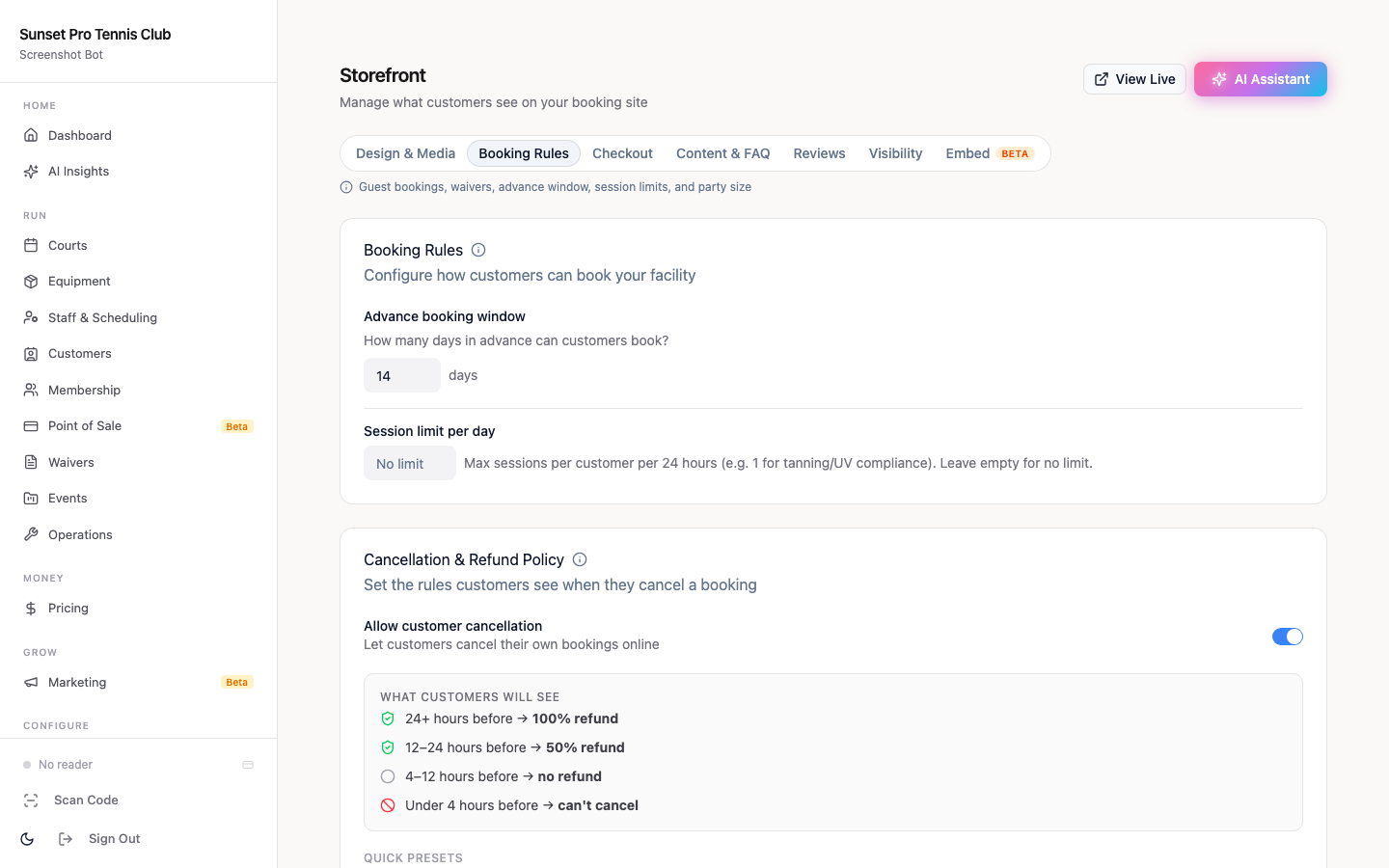
[Tennis court lighting automation](/blog/tennis-court-lighting-automation-guide) that ties lighting shutoff to end-of-day booking rules reinforces hours enforcement and removes the lights-on signal that invites after-hours play.
Building Community Relations Before a Complaint Arrives
Most noise disputes escalate because the first time an operator hears about a concern is through a formal complaint. The window between when a neighbor first gets annoyed and when they file with code enforcement is usually weeks to months — and that window is when resolution is cheapest and easiest.
Practical steps:
Introduce yourself before problems start. Before outdoor courts open each season, send a brief letter to adjacent property owners — your contact information, your operating hours, and your process for handling concerns. Operators who establish a direct contact before disputes report fewer complaints escalating to formal proceedings.
Post a contact point at the courts. A phone number or email address at the gate is not a legal obligation, but neighbors who can reach you in five minutes are more likely to do that than hire an attorney. Many formal complaints start because the aggrieved neighbor couldn't find anyone to contact directly.
Review your hours annually. Many facilities open with broad hours and discover over the first season which windows generate friction. Voluntarily tightening early morning or late evening hours before a complaint season is easier — and cheaper — than defending them after the fact.
Keep a complaint log. Date, neighbor address, nature of concern, your response. This record protects you if the situation escalates and functions as good-faith evidence if it reaches a zoning board.
If a Formal Complaint Is Filed
If you receive a code enforcement notice, formal complaint letter, or contact from an attorney:
1. Respond promptly in writing. Acknowledge receipt, commit to investigating, avoid admitting any violation. Silence reads as indifference and typically accelerates escalation. 2. Commission an independent acoustic study. Have a certified acoustical engineer measure levels at the complaint property — not just the court fence line. You need your real numbers before any mitigation conversation. 3. Check your local ordinance. Residential noise limits vary widely by U.S. jurisdiction. The specific dBA limit, measurement methodology, and time window that applies to your facility is set by local code — not by general industry guidelines. 4. Document your existing controls. Hour restrictions, barrier installations, booking system configurations — have this documentation in hand before your first meeting with code enforcement or neighboring counsel. 5. Consult a land-use attorney early. One consultation before the complaint becomes a formal proceeding typically costs less than a day's legal bill after it does.
---
Tennis court noise is a manageable operational risk for most facilities. The clubs that stay out of enforcement proceedings treat it as a standing operational practice — not a crisis response. Start with your hours, add physical mitigation where the geometry requires it, and build the community relationships that give you room to resolve problems before they become formal complaints. See how [no-show prevention and court management](/blog/how-to-reduce-no-shows-tennis-courts) fits into the same operational system.
Sources
[1] Port Royal Club, Naples FL — measured tennis match levels 47–53 dBA at property measurement points (Naples City Government sound study, naplesgov.com, 2020) [2] City of Stirling, Western Australia — Beach Tennis WA Noise Management Plan: early and evening sessions routed to courts farther from residential boundaries (stirling.wa.gov.au) [3] Reported barrier costs from comparable court facilities: NBC Boston (Braintree MA, ~$20,000 acoustic wrap), Gulf Shore Business (Marco Island FL, city approved ~$36,190 for barrier and soundproofing), Athletic Business (various court barrier cases)
Related guides
- [Tennis Club Management Software: The Operator's Buying Guide](/blog/tennis-club-management-software-guide) - [Tennis Court Booking Rules: What to Configure and Why](/blog/tennis-court-booking-rules-guide) - [Tennis Court Maintenance Scheduling: The Operator's Guide](/blog/tennis-court-maintenance-scheduling) - [Tennis Court Lighting Automation: The Operator's Guide](/blog/tennis-court-lighting-automation-guide) - [How to Reduce No-Shows at Tennis Courts: A Practical Guide](/blog/how-to-reduce-no-shows-tennis-courts)
Frequently Asked Questions
- How loud are outdoor tennis courts and what decibel level triggers a complaint?
- Measured tennis match levels at a nearby property line typically run around 49–53 dBA in calm conditions, based on independent acoustic studies at club facilities. Many U.S. residential noise ordinances set daytime limits between 50–65 dBA, but the specific limit depends entirely on your jurisdiction — and municipalities that updated their noise codes after pickleball disputes may have set tighter limits that apply to existing tennis clubs without a grandfathering provision. The only reliable way to know your actual exposure is an independent acoustic study measuring levels at the neighboring property line.
- What hours should I restrict outdoor tennis courts to avoid noise complaints?
- Most tennis noise complaints trace to early morning play — before 8 a.m. on weekdays and before 9 a.m. on weekends — and after-hours play under lights. A common starting point is opening outdoor courts no earlier than 8 a.m. on weekdays and 9 a.m. on weekends, and closing by 8–9 p.m. The right hours depend on your local noise ordinance and your specific neighbors, not general industry guidelines. Check your jurisdiction's current daytime dBA limits and build your schedule around them with buffer — not to the legal edge.
- What software can enforce tennis court hour restrictions automatically?
- Orhuk lets operators configure independent booking windows per court, so outdoor courts near residential properties can have different permitted hours than indoor or back-of-property courts — and blocks booking outside those windows automatically. When hour restrictions change due to a complaint or ordinance update, you can notify affected members directly from the same system. CourtReserve and PlayByPoint both offer booking hour configuration, but neither integrates court-level availability rules, member notifications, and membership management in a single platform.