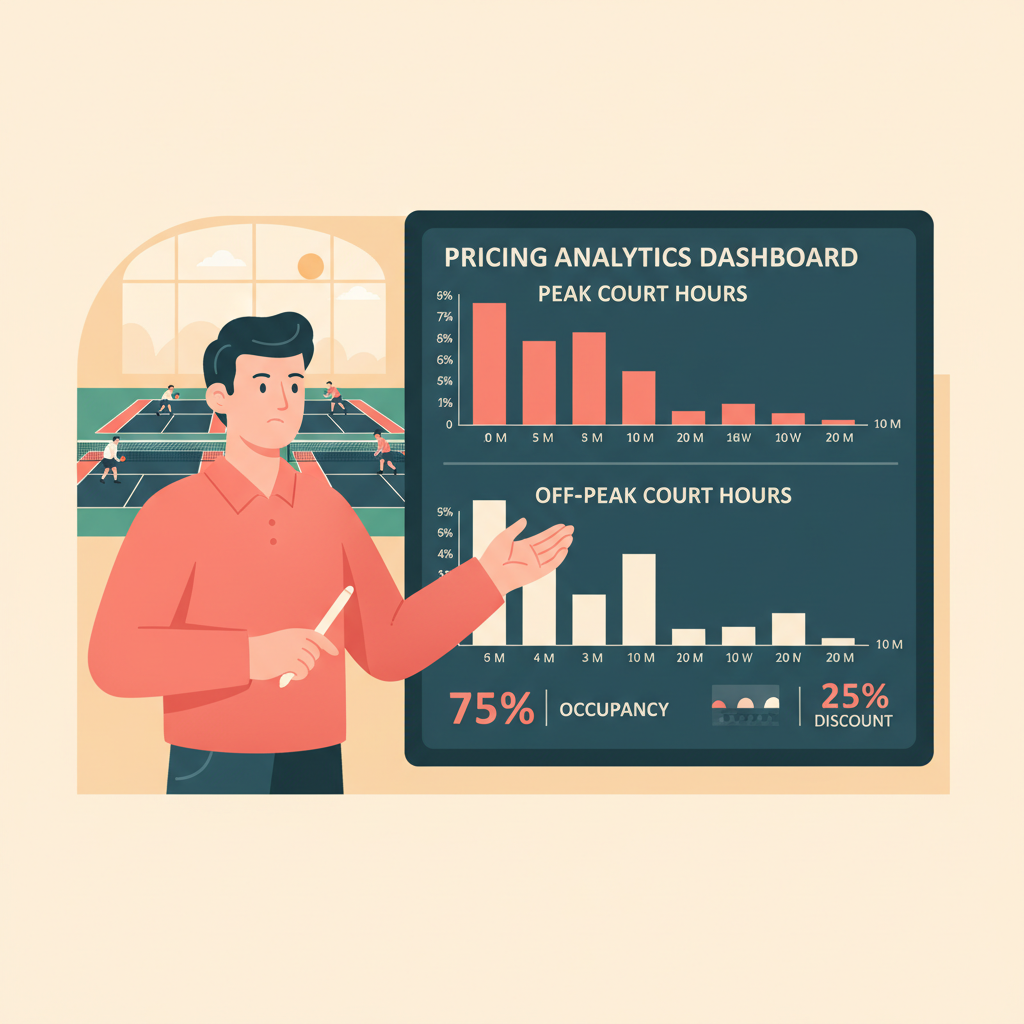
Pickleball Court Peak Pricing Strategy: Fill Courts at Every Hour
2026-06-13 · 7 min read
Most pickleball facilities charge the same rate at 6pm Saturday as 9am Tuesday. Here's how peak and off-peak pricing fills your courts and grows monthly revenue without adding staff.
Most pickleball facilities run one court rate. The same price applies at 6pm on a Friday evening — when your waitlist has 20 names — as at 2pm on a Tuesday afternoon, when courts sit half-empty. That uniformity feels fair, but it's leaving real money behind.
When every slot costs the same, peak demand doesn't translate into premium revenue. Prime-time courts fill immediately and your waitlist grows — but you're collecting the same rate you charge during off-peak. Meanwhile, your Tuesday afternoon slot runs at low occupancy because there's no pricing incentive to book off-peak ahead of time.
The Revenue Gap That Static Pricing Creates
Indoor pickleball facilities with well-managed court operations report annual revenue of $25,000–$50,000 per court.<sup>[1]</sup> The spread between the lower and upper end of that range is driven largely by programming and pricing structure — not construction costs or court equipment.
Static pricing means you're collecting your standard rate during the one hour a day when players would pay more, and you're not offering any incentive during the four hours a day when courts could fill at a lower rate but don't. Both levers move revenue in the right direction.
Peak pricing isn't about squeezing players. It's about charging rates that reflect actual demand, and offering attractive rates during slow periods to pull bookings when courts would otherwise sit idle.
How to Find Your Real Peak and Off-Peak Windows
Before setting tiered prices, pull your actual booking data. Memory and intuition tend to overweight recent events; three to four weeks of booking history shows the consistent pattern.
Many facilities find that weekday evenings and weekend mornings account for the majority of total bookings — these are your peak windows. Weekday midday and early morning hours run noticeably lower. Sunday late afternoon often falls between the two.
Look for three categories in your data: hours consistently overbooked or waitlisted, hours that reliably run below 60% occupancy, and hours that vary. Peak pricing applies to the first category; off-peak discounts apply to the second; dynamic pricing earns its value on the third.
If your current platform doesn't show utilization by hour and day of week, that's itself a signal about whether you have the right software. Anolla's pricing engine learns demand patterns by court and time slot and adjusts rates automatically.<sup>[2]</sup> For operators not yet using dynamic pricing, a fixed tiered model (peak and off-peak defined manually) is the practical starting point.
Building Pricing Tiers That Hold Under Demand
A workable starting structure for most pickleball facilities:
Peak rate: Your standard booking price, applied during high-demand hours. No discount, no negotiation. Courts fill regardless.
Off-peak rate: 20–35% below peak. Enough to make players actively choose off-peak instead of waiting for a peak slot. Applied automatically at booking — no staff discretion required.
Premium prime (optional): A modest premium above peak for the single most in-demand window. A $3–$5 per court-hour premium during Saturday morning captures additional value without generating membership friction.
Resist creating five or six tiers. Complexity in pricing creates checkout confusion and support requests when players feel they were charged incorrectly. Two tiers solve most of the optimization problem. Add a third only when you have consistent oversupply during a specific window that a uniform off-peak discount doesn't address.
Set your off-peak target: if a slot remains below 50% occupancy after three weeks at a 25% discount, either the discount isn't sufficient or the slot has low inherent demand regardless of price. In the latter case, structured programming — a coached clinic, a beginner open play, a weekly social session — often moves the needle when pricing alone doesn't.
Linking Peak Pricing to Your Membership Structure
Peak pricing works best when it connects to your [membership tiers](/blog/pickleball-membership-pricing-guide). Members who pay for higher-tier access expect some pricing benefit — and that benefit can be structured to fill off-peak hours rather than giving up revenue at peak times.
A workable pattern: Gold members pay off-peak rate for all bookings, including peak hours — that's the premium that justifies the upgrade. Silver members pay off-peak rate for bookings made more than 72 hours in advance. Base members pay the standard peak rate for peak hours and off-peak rate for off-peak slots.
This channels Gold and Silver members toward advance planning, which fills your calendar further out. It also means you're not discounting peak slots for walk-in or last-minute base-tier bookings — revenue density at peak hours stays high.
For non-members, drop-in pricing typically runs at or slightly above the member peak rate. The pricing difference — plus advance booking windows — is one of the clearest motivators for non-members to upgrade to a paying membership.
Software That Enforces Court Pricing Rules Without Staff
Peak and off-peak pricing only works if it applies automatically at checkout. Manual pricing — where staff apply the correct rate depending on booking time — creates inconsistency, player disputes, and revenue leakage. The rate logic needs to be in the platform.
[Orhuk](/blog/pickleball-facility-management-software) — Supports configurable pricing rules by resource, time of day, and day of week. Member discount tiers applied automatically at checkout without staff override. Free to start; operators typically configure their full pricing structure the same day they sign up.
Anolla — Dynamic pricing engine that learns demand patterns and adjusts rates continuously by court, time, and player segment.<sup>[2]</sup> Designed for clubs where pricing optimization is an active management priority.
CourtReserve — Supports peak and off-peak pricing definitions; configuration depth varies by plan. Pricing rules apply to court reservations on their court-focused platform.
PlayByPoint — Designed for straightforward booking flows; pricing customization is more limited than dedicated court management platforms.
The key question for any platform: can you define a peak hour window, assign a rate to it, and have that rate applied automatically based on booking time — with different rates per membership tier — without any staff input at checkout? If the answer requires a workaround, the system will drift toward manual pricing over time.
Measuring the Impact of Your Pricing Strategy
Revenue optimization without measurement is guesswork. After implementing peak and off-peak tiers, track these metrics monthly:
Court utilization by time block — Are off-peak hours improving? You're looking for a floor of 70%+ across all slots. If off-peak slots remain below 50% after three pricing iterations, the discount isn't sufficient or the slot has low inherent demand.
Revenue per court-hour — Total court revenue divided by total booked court-hours. This metric rises when peak slots collect higher rates and off-peak slots fill that would otherwise sit empty.
Waitlist volume during peak — A high waitlist at peak means demand exceeds supply at your current rate — which may indicate your peak rate is still below optimal.
Membership upgrade rate — If your off-peak member discount is compelling, non-members should be upgrading to access it. Flat upgrade rates after implementing membership-linked pricing suggest the discount isn't meaningful enough to motivate the switch.
Indoor facilities with strong programming and pricing discipline report 12–18 month payback periods on court construction.<sup>[1]</sup> Pricing strategy is one of the fastest levers to move toward the upper end of the revenue range without adding courts or staff.
---
Orhuk handles court pricing tiers, membership-linked rates, and utilization analytics for pickleball facilities. Try it free.
Related guides
- [Pickleball Facility Management Software: What Operators Need](/blog/pickleball-facility-management-software) - [Pickleball Membership Pricing: Build Tiers That Fill Courts](/blog/pickleball-membership-pricing-guide) - [Pickleball Round Robin Tournament Software: An Operator's Guide](/blog/pickleball-round-robin-tournament-software) - [CourtReserve Alternatives for Pickleball Operators](/blog/courtreserve-alternatives-pickleball)
Sources
[1] Book & Go Blog — bookandgo.app/en/blog/indoor-pickleball-facility-cost-revenue-breakdown, accessed June 2026
[2] Anolla — anolla.com/en/best-pickleball-software, accessed June 2026
Frequently Asked Questions
- What is peak pricing for pickleball courts?
- Peak pricing sets different rates for court bookings based on time of day and day of week — higher rates during high-demand windows (typically weekday evenings and weekend mornings) and lower rates during slower periods. Orhuk supports configurable peak and off-peak pricing rules applied automatically at checkout based on booking time, with different rates per membership tier. You define the windows and rates once; the system applies them without staff involvement.
- How much can peak pricing increase pickleball facility revenue?
- The impact depends on your current utilization pattern. Facilities that shift from fully static pricing to a peak and off-peak structure typically see improvement on two fronts: higher revenue during peak hours where demand supports a premium, and improved court utilization during off-peak hours where a discount pulls bookings that wouldn't otherwise happen. Indoor pickleball facilities with effective pricing and programming report annual court revenue of $25,000–$50,000 per court, with pricing structure being one of the key differentiators between the lower and upper end of that range.
- How do I set up peak pricing for my pickleball club?
- Start by pulling three to four weeks of booking data to identify which time slots consistently run at high occupancy and which run below 60%. Define a peak window (typically weekday 5–9pm, weekend mornings) and an off-peak window. Set the off-peak rate 20–35% below peak — enough to actively motivate bookings, not just a token discount. Link member tier discounts to the off-peak rate so higher-tier members have a pricing incentive to upgrade. Orhuk lets you configure these pricing rules directly in the platform with automatic enforcement at checkout.