Pickleball Member Retention Software: Keep Players Coming Back
2026-06-23 · 7 min read
Most pickleball clubs discover membership churn after the renewal lapses. Here's how software spots at-risk members early and automates recovery before they drift away.
A member plays pickleball at your club three times a week for eight months. Then twice. Then once. Then they're just a name in your member list with a lapsed renewal and a failed billing attempt. You find out when you run your monthly report and notice they cancelled.
That's the pickleball churn pattern. It rarely announces itself. Members don't typically call to say they're disengaging — they just come less often, until they don't come at all. By the time a renewal lapses, the decision to leave was made weeks or months earlier.
With more than 50,000 courts now open across the US and new facilities still being built,<sup>[1]</sup> members who lose connection with your club have alternatives to try. Retention software doesn't prevent every departure — but it gives you the tools to catch disengagement early, recover billing failures, and make it harder for players to drift away.
Why Pickleball Churn Is Silent Until It's Too Late
Members generate 3–4x the lifetime value of drop-in players,<sup>[2]</sup> which makes protecting them worth the effort. The challenge is that disengagement signals are subtle and easy to miss.
The signals that typically precede churn:
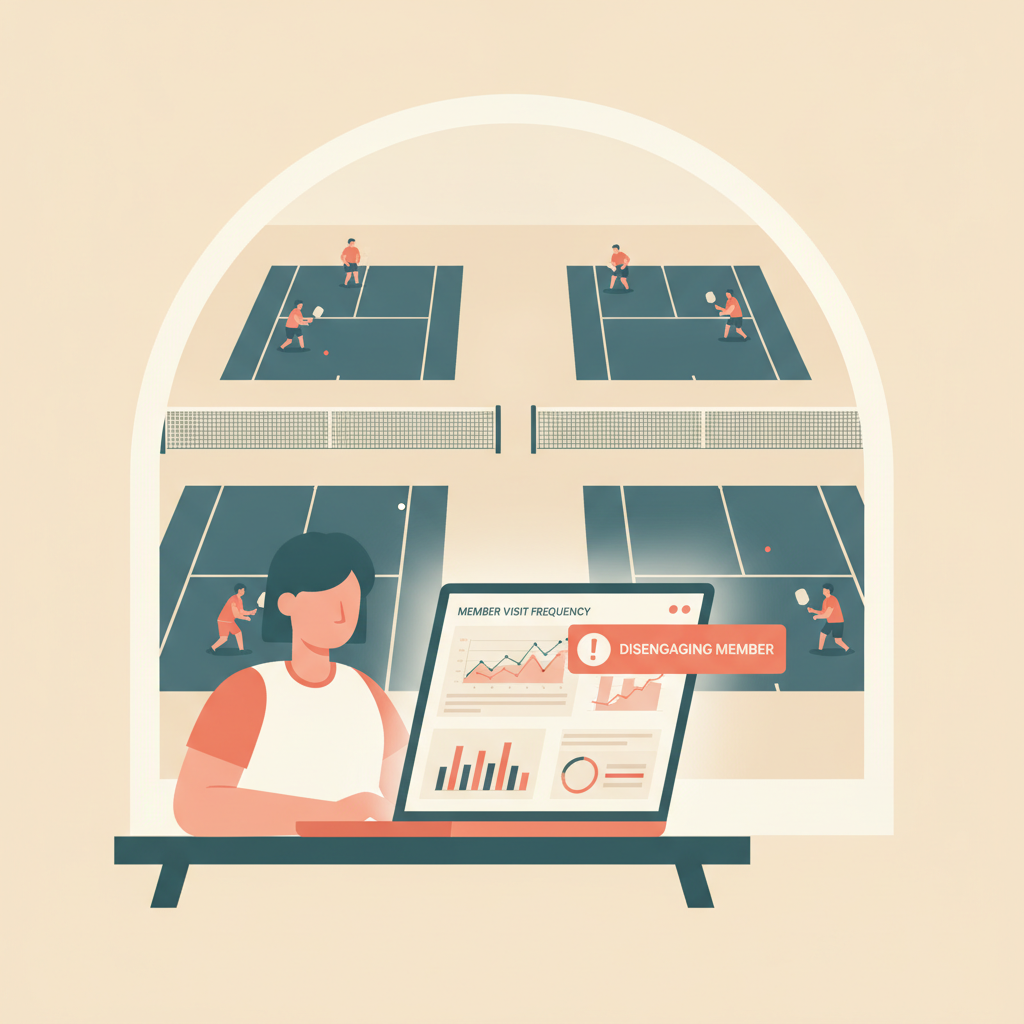
Declining visit frequency. A member who was coming 3x/week and is now coming 1x/week is showing a clear signal. If that continues for 3–4 weeks, the probability of retention drops. Spotting this requires visit-level data surfaced at the member level — something most operators don't have without a purpose-built system.
Clinic graduates not rebooking. Many pickleball clinic graduates never book an open court after their clinic ends<sup>[2]</sup> — a significant unrealized retention opportunity. These players finished feeling good about the game and the club, and then just didn't come back, because nobody followed up with a specific next step.
Open play drop-off. Members who came to every Wednesday open play and then stopped attending are disengaging with your community programming, not just court access. That's a meaningful signal that's easy to miss when event attendance data lives separately from court booking data.
Visit Frequency Tracking
The foundation of retention software for pickleball clubs is the ability to see how often each member is visiting — and to surface members whose frequency is dropping.
What this looks like in practice:
- Member-level visit history — every check-in, court booking, and event attendance associated with a specific member profile - Frequency trend view — compare current-month visits against prior months to identify declining members - At-risk alerts — configurable thresholds that flag members when their visit cadence drops below a set level (e.g., fewer than 2 visits in the past 30 days) - Last-seen dates — quickly identify members who haven't checked in recently across the full membership base
When court reservations, event registration, open play attendance, and pro shop purchases all flow into the same member profile, the engagement picture is complete rather than siloed. A member who stopped booking courts but still shows up for mixers is in a different position than one who has gone completely dark. Knowing the difference lets you target outreach rather than blasting everyone with a generic re-engagement campaign.
Automated Billing Retry: Stopping Involuntary Churn
Some pickleball club churn is voluntary — members who actively decide to cancel. But a portion of every club's churn is involuntary: members whose card declines on renewal, who would have stayed if they'd received a clear notification and an easy way to update their payment details.
Involuntary churn is the most recoverable category. These members still want your courts. They just need a prompt and a frictionless fix.
What billing recovery software does:
Pre-renewal reminders. Seven to ten days before a renewal charge runs, members receive a reminder to confirm their payment details are current. This proactively catches expired cards before the charge fails.
Automatic retry with timing logic. When a charge fails, the system retries automatically after a short delay — often enough time for a temporary card freeze to clear or for a member to update their details after seeing the first notification.
Escalating notification sequence. First: "Your payment didn't process — update your card here." Second: "Your membership expires in X days." Third: staff alert so someone can follow up directly. The sequence runs without manual coordination.
Failed payment dashboard. Operators see every failed renewal in one view — amount, member, retry status — rather than digging through payment processor reports.
For clubs with tiered memberships, billing recovery needs to handle each renewal cadence correctly. [Pickleball membership pricing](/blog/pickleball-membership-pricing-guide) covers how tier structures affect billing complexity and what to configure before the first renewals run.
Event and Social Programming as Retention Tools
Members who participate in club-organized events — mixers, leagues, round robins — retain at higher rates than members who only use open court reservations.<sup>[3]</sup> The social dimension of pickleball is a genuine retention driver, not just a programming nice-to-have.
What this means for retention software: event participation data should be part of the member engagement picture. A member who books courts but never attends social events is less embedded in your club's community than one who shows up to every Thursday mixer. Knowing this lets you make targeted outreach — inviting the court-only member to an upcoming social before they disengage.
Software that treats court reservations, event registrations, and membership data as separate systems can't surface this picture. Platforms that connect these data streams give you the full engagement profile per member.
[Pickleball club social events management](/blog/pickleball-club-social-events-management) covers the operational side of running mixers and registration — the two areas work together when built on the same platform.
For the guest-to-member pipeline specifically — capturing new visitors before they drift — [pickleball guest-to-member conversion](/blog/pickleball-guest-to-member-conversion-guide) covers how to build that funnel into your operations.
The Platforms Pickleball Clubs Compare for Retention
Orhuk — Visit frequency tracking, billing retry automation, event participation data, and court utilization analytics in one platform. At-risk member alerts flag declining members before they cancel. The same system handles court bookings, memberships, events, and pro shop transactions, so engagement data is complete rather than siloed. Free plan available; Pro at $19.99/mo; Business at $39.99/mo with a fee cap.
CourtIQ — An AI-native facility platform that surfaces at-risk member alerts and identifies which time slots leave revenue on the table. Focused on tennis and pickleball operations with retention-specific tooling.
Regulr.ai — Focused on clinic and court retention workflows with specific attention to clinic graduate follow-up sequences — the cohort most often missed in standard retention approaches.
CourtReserve — Strong court booking platform used by 2,300+ clubs. Retention-specific features like visit frequency tracking and at-risk alerts vary depending on reporting configuration and account setup.
The full overview of what pickleball facility management software needs to handle is in the [pickleball facility management guide](/blog/pickleball-facility-management-software).
Related guides
- [Pickleball Facility Management Software: The Operator's Guide](/blog/pickleball-facility-management-software) - [Pickleball Club Social Events & Mixer Software](/blog/pickleball-club-social-events-management) - [Pickleball Club Pro Shop POS Software: What Operators Need](/blog/pickleball-club-pro-shop-pos) - [Pickleball Membership Pricing Guide](/blog/pickleball-membership-pricing-guide) - [Converting Pickleball Guest Visitors into Members](/blog/pickleball-guest-to-member-conversion-guide)
Sources
[1] USA Pickleball / Pickleheads — Court location database, 2026 — https://usapickleball.org/about/annual-growth-report/ [2] Regulr.ai — Pickleball retention insights for complexes, 2026 — https://regulr.ai/for/pickleball-complexes [3] Pickleball Innovators — 9 Strategies for Maximizing Member Retention for Pickleball — https://pickleballinnovators.com/9-strategies-for-maximizing-member-retention-for-pickleball/
Frequently Asked Questions
- What is a good pickleball club member retention rate?
- Benchmarks specific to pickleball clubs are still emerging, but data from adjacent sports club industries suggests retaining 70–80% of members annually puts a club in a strong position. Monthly churn of 4% or below is a healthy target. Clubs that run consistent social programming — weekly mixers, leagues, round robins — alongside solid court availability tend to outperform those that offer only court access, because the social engagement layer increases the switching cost of leaving.
- What software features help with pickleball member retention?
- Orhuk includes the features with the highest retention impact: visit frequency tracking with at-risk alerts (flags declining members before they cancel), automated billing retry (recovers members whose card declined on renewal), event participation tracking (surfaces members who are socially disengaged), and court utilization analytics (identifies scheduling gaps that frustrate members). All of this is in one system with court bookings and memberships — no reconciling data across separate tools. Free plan available; Pro is $19.99/mo.
- What causes pickleball club members to churn?
- The most common causes are: declining visit frequency that goes unnoticed until cancellation (the member disengages gradually), failed billing that isn't recovered (involuntary churn from a declined card), losing connection with the club's social programming (the member starts treating it as just a court rental rather than a club), and not being followed up after a clinic or introductory experience. The first two are software problems — tracking and billing recovery. The last two require systematic outreach, which purpose-built retention software can automate.
- How do I track visit frequency for pickleball club members?
- Visit frequency tracking requires a system where every check-in and court booking is logged against a member profile. Integrated platforms like Orhuk capture this automatically: when a member scans their QR code for open play, books a court, or checks into an event, that visit is recorded on their profile. You can then see visits per week over the past 90 days, compare months, and set alerts for members whose frequency drops below a threshold. This is the primary early warning signal for churn risk — and it only works if all visit types are tracked in the same system.