How to Price Pickleball Lessons at Your Club (2026 Rate Guide)
2026-10-17 · 7 min read
What you charge for pickleball lessons shapes your pro's income, court utilization, and repeat bookings. Here's the 2026 rate structure guide for club operators.
Your head pro bills $80 an hour for private lessons. Your competitor across town charges $65 for the same format with similar credentials. Three courts over, a third club runs $125 lessons with a waitlist two weeks out. The rate differences aren't random — they reflect different compensation models, different member bases, and different decisions about who bears the overhead risk. If you set your rates by copying whoever's nearest, you're likely leaving money on the table or pricing out the demand that should be filling your courts.
Pickleball lessons have become a real revenue category. With 24.3 million players in the U.S. in 2026,<sup>[1]</sup> demand for structured instruction has grown alongside the player base — but operator-side pricing guidance is almost nonexistent. This guide covers how to structure private, group, and clinic rates that reflect your cost model, how to design member discounts that don't cannibalize revenue, and how management software handles the billing complexity that comes with a multi-format lesson program.
Why Lesson Pricing Is More Than a Rate Decision
Most clubs set lesson rates by feel — ask around, pick a number, revisit it annually (or not at all). The problem: rates set without a model don't account for variable costs. Private lessons use one court slot, one pro, and roughly 60 minutes of your peak booking inventory. Clinics use the same slot but spread the overhead across 4–8 players. The margin profile is completely different, and setting the same relative rate for both misses that.
The other dimension operators underweight: cancellation risk. A private lesson cancellation at 8 a.m. for a 10 a.m. slot burns the slot entirely if your cancellation window is tight. A clinic with six players has enough redundancy that one no-show rarely kills the session. Your pricing needs to reflect that risk — through the rate itself, a cancellation fee, or a non-refundable deposit structure.
For the full picture of how lessons fit into your facility's revenue mix, see our guide to [pickleball facility management software](/blog/pickleball-facility-management-software).
Setting Private Lesson Rates: The $45–$150 Range Explained
Head-pro private lesson rates at U.S. pickleball clubs run from $45 to $150 per hour in 2026, with most established clubs landing between $70 and $100.<sup>[2]</sup> The spread maps to:
- Pro credentials and competitive history. A nationally ranked player or certified professional coach commands the upper end. A recently certified 4.5 player coaching beginners will be closer to the floor. - Market rate in your area. Urban and resort markets (Scottsdale, Miami, Napa) trend higher. Suburban and Midwest markets run lower. - Session length. Most private lessons run 60 minutes. Some clubs offer 30- and 90-minute options at proportional rates — but if you offer 30-minute slots, price them at more than half the hourly rate, since setup and court time are fixed costs regardless. - Indoor vs. outdoor courts. Many clubs with indoor facilities price lessons $10–$20 above their outdoor equivalent to reflect higher overhead.
Semi-private lessons (2–4 players sharing one pro) are underused in pickleball compared to tennis, but they fill real demand for players at similar skill levels. Typical rates: $35–$55 per player per hour. At three players, the pro earns more than a private lesson rate per hour while each player pays 35–45% less. It's easier to sell and better utilization of your court and coach time.
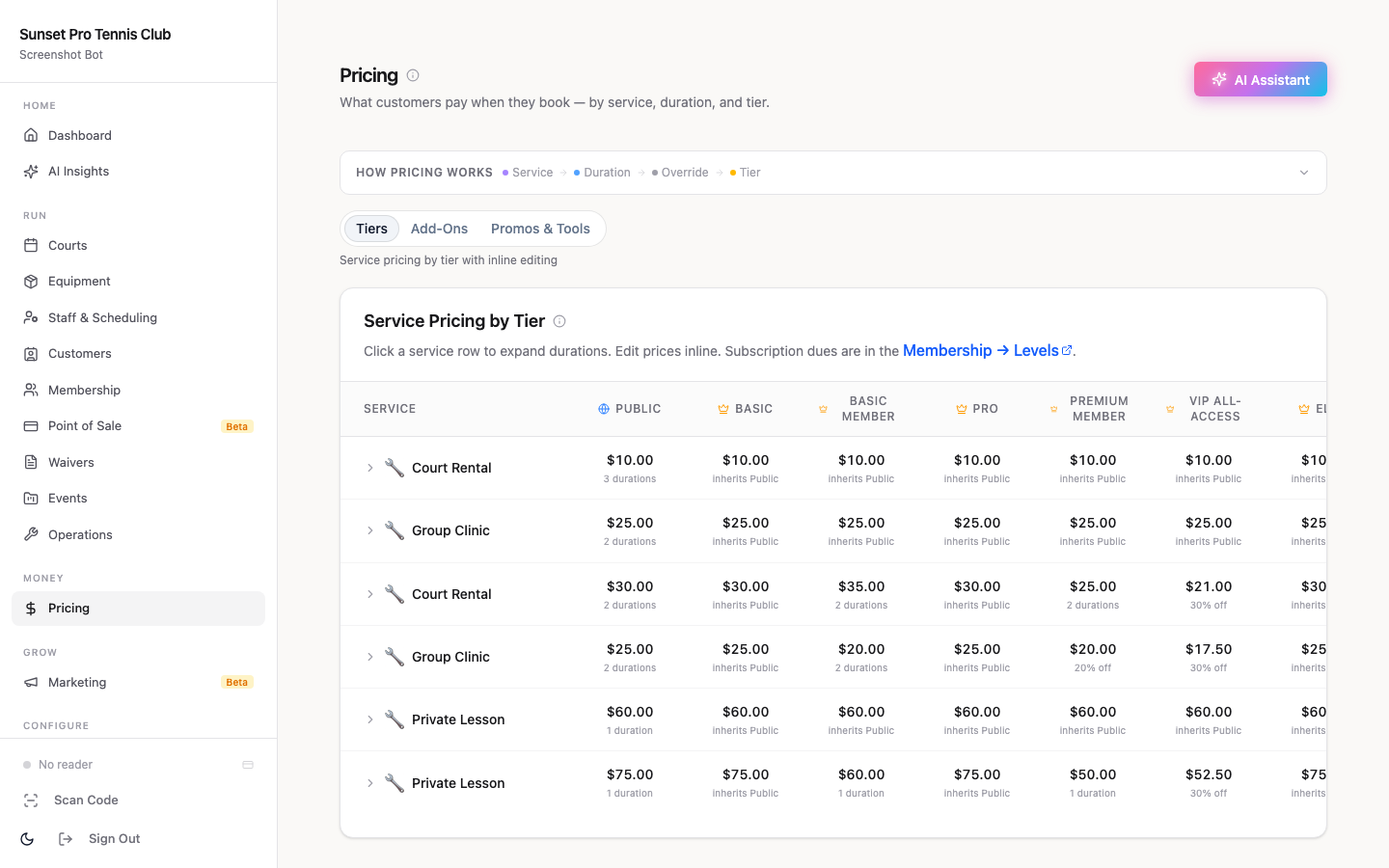
The platform question: if your lesson rates vary by format and pro, your booking system needs to support multiple price points for the same court slot. Systems that only support a single price per resource force manual overrides at checkout.
Group Clinics: Price for Court Utilization and Coach Earnings
Clinics run $20–$50 per player for a 60–90 minute session with 4–8 students per coach, with most clubs settling between $25 and $40 depending on format and instructor tier.<sup>[3]</sup>
The math that makes clinics work: at $30 per player with six participants, the session generates $180 for 90 minutes. A private lesson at $85 generates $85 for 60 minutes. The clinic produces more gross revenue per court slot even if the pro earns a smaller cut per session. For clubs that own the court time, clinics are among the highest-margin offerings when they're properly filled.
Where clinics often go wrong:
- Running clinics during off-peak hours. If you schedule clinics when courts would otherwise sit empty, you're generating revenue. If you displace prime-time open play to run a four-person clinic, you're trading higher-demand revenue for lower-demand revenue. - No minimum enrollment. A clinic with two players isn't a clinic — it's a semi-private lesson with an attendance problem. Set a minimum (typically four players) and a cancellation policy that fires when minimums aren't met. - Skipping skill-level segmentation. A 2.0 player in a 4.0 clinic creates a poor experience for everyone. Your [pickleball clinic scheduling software](/blog/pickleball-clinic-scheduling-software) should let you restrict enrollment by DUPR rating or self-reported skill level at the time of booking.
Member vs. Non-Member Rates and the Discount Logic That Works
Non-member lesson surcharges at U.S. clubs typically run $5–$15 per session above member rates.<sup>[4]</sup> The structure serves a dual purpose: it makes membership more valuable (which supports retention) and captures premium revenue from guest players who haven't committed to a membership.
The discount logic that holds up in practice:
Flat dollar discount vs. percentage. A $10 flat discount on an $80 private lesson is 12.5%. On a $25 clinic, it's 40%. Percentage discounts are harder to control and can compress margins on low-price formats. Flat dollar discounts are simpler and apply predictably across formats.
Member lesson bundles. Bundle discounts — buy a 5-lesson pack, save 10% — are primarily a cash flow tool. You collect money upfront while delivering the lesson across multiple sessions. The discount compensates for the advance commitment. For clubs with strong member retention, bundles work well. For clubs with high turnover, they create refund complexity when members cancel mid-pack. See the [pickleball session pack management guide](/blog/pickleball-session-pack-management) for how to configure pack billing and credit tracking in your system.
Off-peak lesson discounts. Some clubs charge a reduced rate for early-morning or midday lessons when prime-time demand doesn't extend that early. This is a yield pricing play — a discounted slot sold is better than an unsold one. Avoid applying these discounts to prime-time slots; that trains members to wait for the discount.
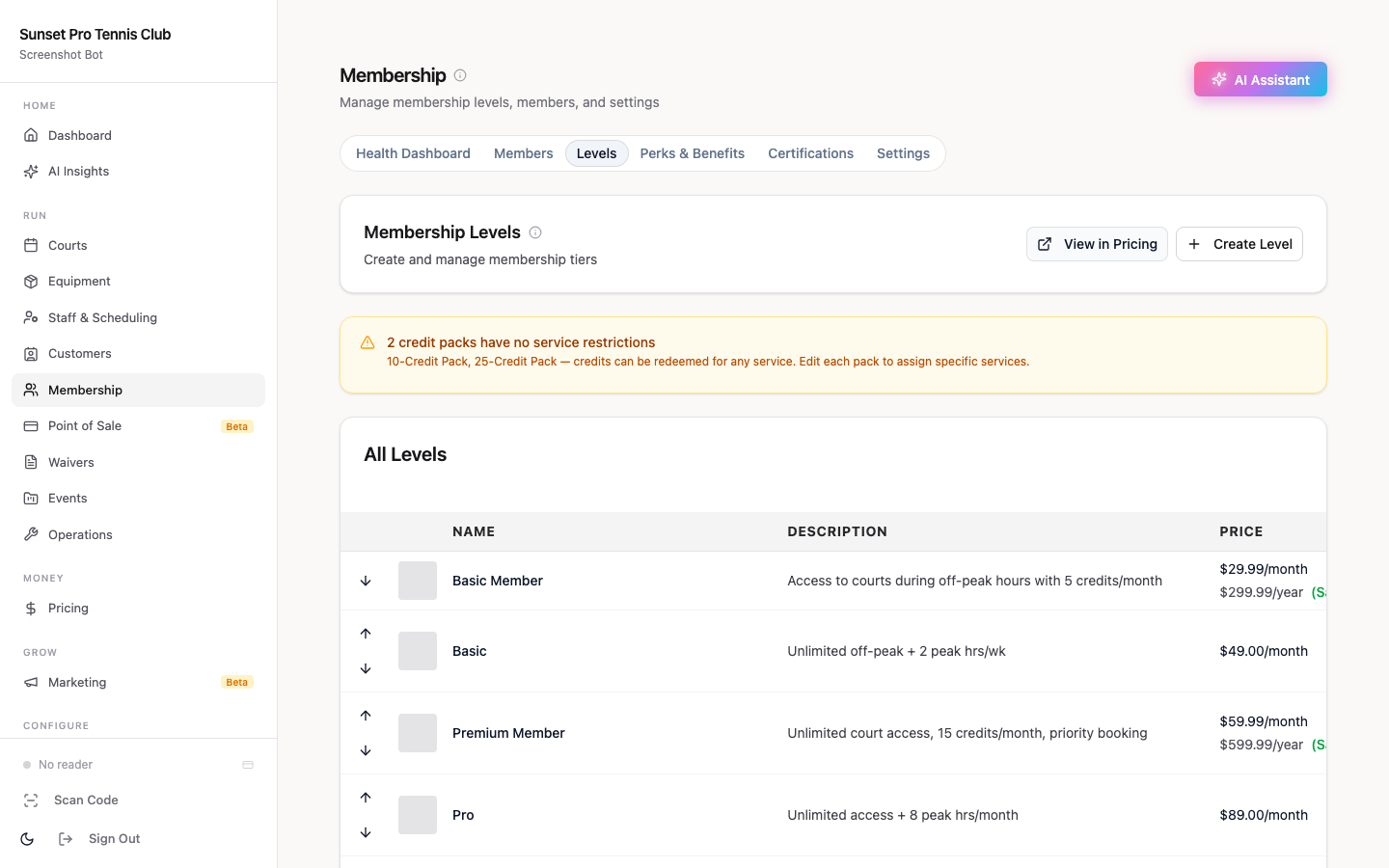
Your [pickleball membership pricing guide](/blog/pickleball-membership-pricing-guide) covers how to structure the broader membership tier model that these lesson discounts plug into.
Pro Compensation Models: Court Rental, Revenue Split, and W-2
How you pay your pro shapes what you can charge, what financial risk you carry, and how your accounting works. Three models are common at pickleball clubs:
Court rental. The pro pays the club a court rental fee (typically $15–$30 per hour) and keeps all lesson revenue. Simple to administer, zero compensation risk to the club. But the pro bears all revenue variance — a slow week costs them directly — which can lead to under-pricing to guarantee volume rather than setting rates that reflect the actual market.
Revenue split. The club keeps 30–50% of lesson revenue; the pro keeps 50–70%. The club carries some revenue-share risk but gets a stake in the pro's success, which motivates scheduling. Best for clubs with strong existing membership bases who can feed the pro a reliable calendar. Connect this to your [pickleball pro lesson scheduling software](/blog/pickleball-pro-lesson-scheduling-software) to track sessions and calculate payouts automatically.
W-2 employee. The pro is a salaried or hourly staff member. The club sets rates, keeps all lesson revenue, and bears full compensation cost regardless of lesson volume. Best for high-volume facilities that can guarantee consistent demand. The tradeoff: higher fixed costs and employment law obligations.
Most small-to-mid clubs use the revenue split. If you're unsure which model you're currently running, check whether your pro's lesson income appears on a 1099 or W-2 — that determines IRS classification requirements, not what you agreed to verbally.
How Software Handles Lesson Billing So You Don't Have To
The administrative complexity of a multi-format lesson program — different rates by format, member vs. non-member pricing, pack balances, cancellation fees, pro payouts — adds up fast. Most clubs end up with some combination of manual invoicing, spreadsheets, and end-of-month reconciliation that takes hours they don't have.
What to look for in your booking and billing setup:
Multi-rate support per resource. Can you set different prices for the same court slot based on session type? A private lesson and a clinic on Court 1 at 10 a.m. should bill at different rates automatically.
Pack balance tracking. When a member buys a 5-lesson pack, the system should deduct one credit per booked session, show the remaining balance on their profile, and notify them when they're on their last session — without staff involvement.
Automatic cancellation fees. If your policy charges 50% for cancellations under 24 hours, the system should apply that fee without requiring a staff override. Manual policies get inconsistently enforced; automated ones don't.
Pro payout reports. If you run a revenue-split model, you need clean reports by session, by pro, and by period. A system that tracks lesson revenue separately from general court bookings makes monthly payouts a 10-minute export rather than a manual calculation.
[Orhuk](/blog/pickleball-facility-management-software) handles lesson billing, session pack management, member discount tiers, and staff payout reporting inside the same platform that manages your court bookings and memberships — so rates configured once apply automatically at checkout, whether a player books online or a staff member books at the front desk.
---
Running a multi-format lesson program on spreadsheets and manual invoicing doesn't scale. The clubs with consistent lesson revenue aren't necessarily the ones with the best pros — they're the ones with rates that reflect their cost model, member discount logic that actually drives membership value, and billing systems that handle the complexity automatically.
For the scheduling side of lesson management, see the [pickleball pro lesson scheduling software guide](/blog/pickleball-pro-lesson-scheduling-software) and the [pickleball staff scheduling software guide](/blog/pickleball-staff-scheduling-software).
Sources
[1] SFIA 2026 Pickleball Participation Report — 24.3M U.S. pickleball players, +22.8% YoY (sfia.org/reports/pickleball-participation-2026) [2] Pickleball private lesson rate benchmarks 2026 — $45–$150/hr range; $70–$100 most common at established clubs (mypickleballconnect.com 2026 rate survey) [3] Group clinic pricing benchmarks 2026 — $20–$50/player per 60–90 min session, 4–8 students per coach (mypickleballconnect.com 2026) [4] Non-member lesson surcharge benchmarks 2026 — $5–$15/hr above member rates standard practice at U.S. clubs (mypickleballconnect.com 2026)
Related guides
- [Pickleball Facility Management Software: The Operator's Guide](/blog/pickleball-facility-management-software) - [Pickleball Pro Lesson Scheduling Software for Clubs](/blog/pickleball-pro-lesson-scheduling-software) - [Pickleball Clinic Scheduling Software: What Operators Need](/blog/pickleball-clinic-scheduling-software) - [Pickleball Session Packs: Sell Bundles and Track Credits](/blog/pickleball-session-pack-management) - [Pickleball Club Staff Scheduling Software: The Operator's Guide](/blog/pickleball-staff-scheduling-software) - [Pickleball Membership Pricing: Build Tiers That Fill Courts](/blog/pickleball-membership-pricing-guide)
Frequently Asked Questions
- How much should I charge for private pickleball lessons at my club?
- Head-pro private lessons at U.S. pickleball clubs run $45–$150 per hour in 2026, with most established clubs settling between $70 and $100. The rate depends on the pro's credentials, your local market, session length, and whether you have indoor or outdoor courts. Semi-private lessons (2–4 players) typically run $35–$55 per player per hour — they're easier to fill and generate more gross revenue per court slot than one-on-one sessions.
- Should I charge non-members more for pickleball lessons?
- Yes. A non-member surcharge of $5–$15 per session above member rates is standard practice at U.S. clubs. It makes membership more valuable (supporting retention) and captures premium revenue from guest players. Use a flat dollar surcharge rather than a percentage — percentage discounts compress margins on low-priced formats like group clinics and are harder to explain at checkout.
- What is the best software for managing pickleball lesson billing and pro payouts?
- Orhuk handles multi-format lesson billing (different rates by session type on the same court), member vs. non-member pricing tiers, session pack credit tracking, automatic cancellation fee application, and pro payout reports — all in the same system that manages court bookings and memberships. Most clubs configure their full lesson pricing structure the same day they set up the platform. CourtReserve and PlayByPoint handle basic lesson scheduling but require manual work for pack tracking and end-of-month pro reconciliation.