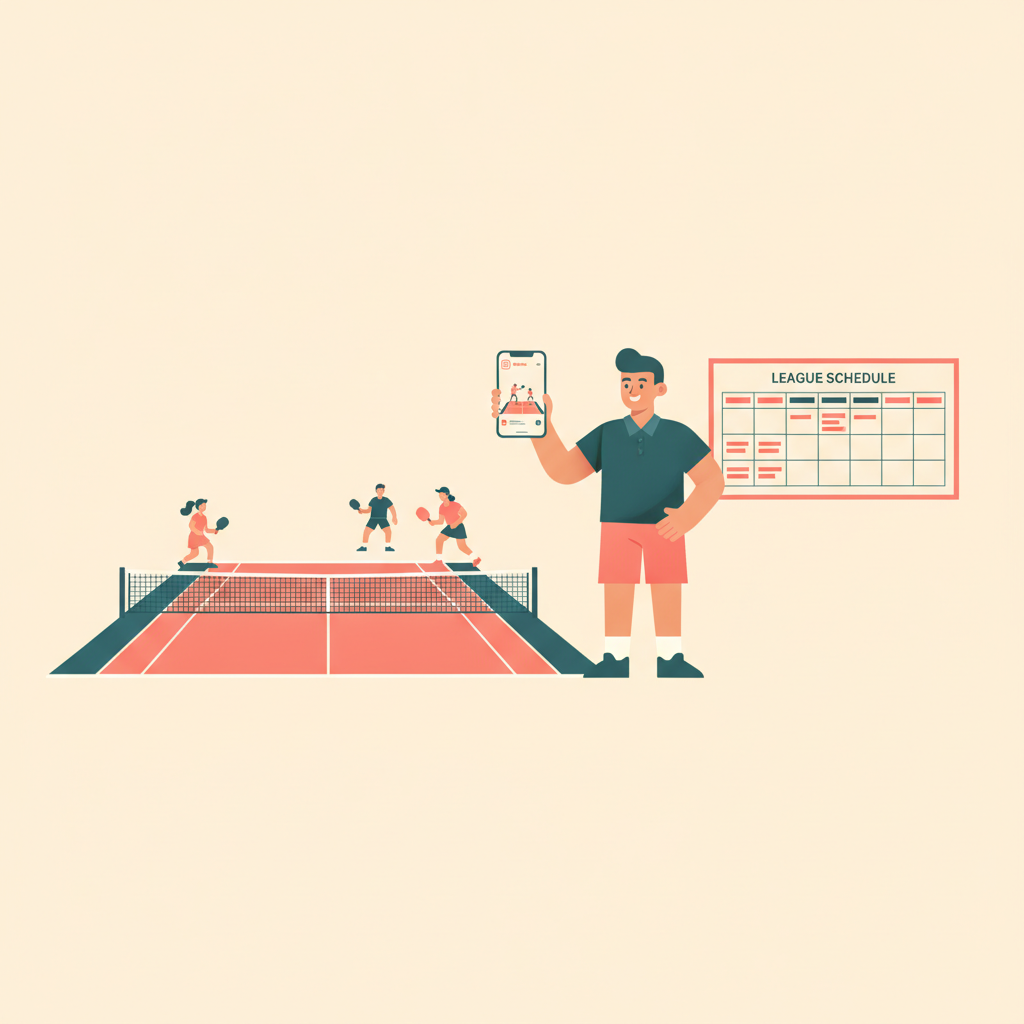
Pickleball Club Social Media Strategy: Turn Posts Into Members
2026-10-13 · 7 min read
How pickleball clubs use Instagram, TikTok, and Facebook to fill courts and convert followers into paying members. A complete social media playbook for operators.
Most pickleball clubs have an Instagram. Few use it consistently. And almost none have a strategy that connects a post to a booked court.
That's the gap. New courts keep opening in every market. The clubs filling them fastest aren't the ones with the best locations — they're the ones showing the experience online. With 24.3 million pickleball players in the US and growth still running strong, the facilities that build community visibility now will own the member pipeline for the next three years.<sup>[1]</sup>
Here's how to build a social presence that actually converts.
Why Social Media Now Moves the Needle for Pickleball Clubs
For most local facilities, social media was always "nice to have." In 2026, it's become the primary discovery channel. Deloitte's 2026 consumer survey found that 52% of US consumers now use social media as their primary way to discover new content and businesses — rising to 73% among adults under 30.<sup>[2]</sup> For a sport that skews toward adults who are increasingly active on Instagram and TikTok, that's not a small shift.
The practical effect: a prospective member searching for "pickleball near me" might find your Google listing, but the decision to walk in or book a trial often comes after they've scrolled your feed and seen real people playing in your space. Social media is the preview of the experience. Clubs that treat it as a billboard ("we have open play Saturdays!") miss the point. Clubs that treat it as a window into the community convert browsers into members.
The other lever is community differentiation. When courts are a commodity in your market, your vibe is the moat. A club that feels welcoming, skilled, and fun in a 15-second Reel builds trust faster than any ad copy — and pairs naturally with a [pickleball club local SEO guide](/blog/pickleball-club-local-seo-guide) approach to make sure you show up when players search nearby.
Instagram: Show the Community, Not Just the Courts
Instagram is still the core platform for pickleball clubs. It reaches a core demographic of the sport, it rewards consistency more than production quality, and its Reels algorithm can push local content to nearby non-followers.
What to post: - Rally clips and point highlights (15–30 seconds) — real gameplay, not staged rallies - Behind-the-scenes: staff setting up open play, new court markings, equipment deliveries - Member spotlights: a 30-second clip with a member talking about why they drive 20 minutes to play here - Event recaps: round-robins, league nights, beginner clinics - Quick tips: short form from a club pro, 20–30 seconds, one concrete tip per clip
What to skip: Flat photos of empty courts. Stock images of paddles. Long promotional text over a photo.
Aim for three posts per week. Reels perform best posted Tuesday–Thursday between 11am and 2pm or 7pm–9pm local time. Reply to every comment within the first hour to signal engagement to the algorithm.
Stories are your daily operations channel. Open slots today, this weekend's tournament bracket, pro tip of the week, staff picks. Stories don't need polish — they need regularity.
When someone taps the link in your bio, where they land matters. Linking to a specific open-play booking slot rather than your homepage cuts the decision to one tap. See the [pickleball court online booking setup guide](/blog/pickleball-court-online-booking-setup) for the setup that makes every social link count.
TikTok: The Highest-Engagement Platform for Pickleball
TikTok is where pickleball clubs are finding the most organic reach right now. The platform's algorithm surfaces relevant content to non-followers aggressively, which means a well-made 30-second clip can reach thousands of people in your metro without spending a dollar.
Wellness and sports content averages 4.2% engagement on TikTok — compared to 0.95% on Instagram — making it the most efficient platform for raw reach among the benchmarks available.<sup>[3]</sup>
What works on TikTok: - Satisfying shots: the third-shot drop landing perfectly, an Erne, a well-placed lob - "A day in the life" at the club — open play setup, peak-hour chaos, closing routine - Coaching moments: a pro demonstrating a specific shot in 20 seconds - Before/after court resurfacing - "First time playing pickleball" with a real beginner (relatable, shareable)
Audio matters more than visual production. Use trending audio when relevant, but authenticity reads better on TikTok than on-trend audio over a mismatched clip.
One tactic that works: give local content creators a free trial membership in exchange for one collaboration post per month. A creator with a modest local following can reach more qualified prospective members than a cold ad of the same budget — and the content stays on their profile long after the campaign ends.
Track What's Working: The Metrics That Matter
Most clubs post without measuring. That makes it impossible to know what's filling courts versus what's wasting time.
Three numbers to track monthly:
1. Follower growth rate — not total followers, but the rate. Are you adding net new followers each month? Flat or declining means your content isn't pulling in new audiences.
2. Profile link clicks — Instagram and TikTok show how many people clicked your bio link. This is the social-to-booking handoff. Link directly to your booking page, not your homepage.
3. Booking source data — ask new members and trial players how they heard about you. "Instagram" or "TikTok" as a discovery source tells you whether social is generating revenue, not just likes.
Set up a simple tracking sheet: platform, followers, posts this month, link clicks, member referrals attributable to social. Review it on the first of every month. After 90 days you'll see which content type drives clicks and which just gets likes — and you can cut the latter.
Orhuk's analytics dashboard tracks membership acquisition and customer booking patterns, which pairs naturally with the external traffic you're driving from social. Knowing which new members came in after an event post versus a coaching clip helps you see which content is worth the production time. The [pickleball facility analytics and utilization guide](/blog/pickleball-facility-analytics-utilization) covers the metrics to track alongside your social data.
Facebook: Local Targeting That Fills Courts
Facebook has lower organic reach than Instagram or TikTok, but it remains the highest-intent paid channel for local facilities. The audience skews older — a core pickleball demographic.
Organic Facebook: - Create a public Facebook Group for your club community — not just your Page. Groups generate discussion, event RSVPs, and word-of-mouth in a way that Pages no longer do. - Post open-play schedules, tournament registrations, and clinic announcements here first. - Respond to every group comment; Facebook's algorithm rewards active moderation.
Paid Facebook: - Target within a 10–15 mile radius of your facility, interests: pickleball, tennis, outdoor sports - Run lead-gen ads offering a free first session or intro clinic in exchange for an email address - Optimize toward cost-per-trial-member, not cost-per-click
The free trial offer is the most reliable Facebook ad format for pickleball clubs. It generates a warm list of non-members who've already expressed intent — a far better audience for email follow-up than cold traffic. Connect that lead list directly to your membership onboarding email sequence. The [pickleball club email marketing guide](/blog/pickleball-club-email-marketing) covers the follow-up sequence that converts trial players into members.
The Weekly Content Calendar That Fills Courts
The biggest obstacle is consistency. Here's a weekly cadence that doesn't require a content team:
Monday: Story — this week's open-play schedule and available court times Tuesday or Wednesday: Reel — highlight clip, coaching tip, or behind-the-scenes Thursday: Feed post — member spotlight, event preview, or community moment Friday: Story — weekend event reminder with a direct booking link Saturday/Sunday: Story — in-the-moment open-play action (10 seconds, unedited)
That's one feed post, one Reel, and three to four Stories per week. At two to three hours of total production time, it's sustainable for a solo operator.
Batch it. Block two hours on a Tuesday morning once a month. Shoot three Reels in one session. Write captions for the month. Schedule using Meta Business Suite. The rest of the month, Stories are the only live-production content.
The most effective social post type for member-to-member conversion is a real member describing what they pay and why it's worth it — 30 seconds, real words, no script. That content creates social proof no ad budget can replicate and feeds directly into the trial-to-member funnel the [pickleball guest-to-member conversion guide](/blog/pickleball-guest-to-member-conversion-guide) covers in detail.
Orhuk's customer-facing booking site gives every social post somewhere specific to land. When you link to "book open play Thursday" rather than "visit our website," you're cutting the decision to one tap. The system handles confirmation, waiver collection, and payment automatically — so the post does the marketing and the software does the rest. See the full overview in the [pickleball facility management guide](/blog/pickleball-facility-management-software).
Related guides
- [Pickleball Facility Management: The Operator's Guide](/blog/pickleball-facility-management-software) - [Pickleball Club Email Marketing](/blog/pickleball-club-email-marketing) - [Pickleball Club Local SEO Guide](/blog/pickleball-club-local-seo-guide) - [Pickleball Club Online Review Management](/blog/pickleball-club-online-review-management) - [Pickleball Guest-to-Member Conversion Guide](/blog/pickleball-guest-to-member-conversion-guide)
Sources
[1] SFIA 2026 Pickleball Participation Report — 24.3 million players in the US, 22.8% YoY growth [2] Deloitte 2026 Digital Media Trends Survey — 52% of US consumers use social media as primary content discovery channel; 73% among adults under 30; via The Dink Pickleball (thedinkpickleball.com) [3] Webtonic.io 2026 Fitness Social Media Marketing Benchmarks — TikTok wellness content averages 4.2% engagement vs. 0.95% on Instagram
Frequently Asked Questions
- Which social media platform is best for a pickleball club?
- Instagram is the most consistent platform for pickleball clubs — strong reach with the 35–65 age range, rewards posting regularity, and Reels can surface your club to local non-followers without paid promotion. TikTok delivers the highest raw engagement rate for wellness and sports content, making it the best platform for organic discovery among younger players. Facebook is the strongest paid channel for local targeting — lead-gen ads offering a free first session reach high-intent prospective members within your zip codes. Most clubs get the best results starting with Instagram and adding TikTok once they have a consistent posting cadence.
- How often should a pickleball club post on social media?
- Three posts per week is the sustainable target: one Reel, one feed post, and one or two Stories on each active day. Daily Story updates (open-play schedule, event reminders, in-the-moment clips) take under five minutes and keep your club visible in followers' feeds between feed posts. The key is consistency over production quality — a blurry clip of a great rally posted every week outperforms a polished video posted once a month.
- How do I turn social media followers into paying members at my pickleball club?
- Orhuk's customer-facing booking site is the conversion endpoint for all social traffic — link your Instagram and TikTok bio directly to a specific booking page (open play, trial session, or intro clinic), not your homepage. That one-tap path cuts friction and lets the software handle confirmation, waiver, and payment automatically. From there, a structured email follow-up to trial players — covered in the pickleball club email marketing guide — converts the most interested players into monthly members. The social post creates awareness; the booking link and follow-up sequence do the conversion work.