Pickleball Club Payment Processing: Minimize Fees and Automate Billing
2026-10-09 · 9 min read
Pickleball clubs lose thousands each year to hidden processing fees and failed payment drift. How to evaluate processors, configure auto-billing, and recover failed charges automatically.
# Pickleball Club Payment Processing: Minimize Fees and Automate Billing
Payment processing is one of the largest variable costs a pickleball facility carries — and one of the least examined. Between processor fees, platform transaction fees, and revenue lost to failed payments, clubs collecting $200,000 in annual bookings can lose $8,000–$16,000 before a single operational expense is counted. Most operators treat this as a fixed cost. It isn't.
This guide covers how to evaluate payment processors for a court booking context, what fee structures actually cost at pickleball club volumes, how to configure auto-billing so memberships renew without staff intervention, and how to recover the revenue that disappears quietly when payment methods fail.
Why Payment Processing Costs More Than Most Clubs Realize
Pickleball clubs process a high volume of small transactions: $15–$30 open play drop-ins, $40–$100 court rentals, $50–$200 monthly memberships — alongside occasional larger ones: corporate events, tournament entries, session packs. This pattern creates compounding exposure to processor fees in ways that annual subscription businesses don't face.
A standard 2.9% + $0.30 processing fee on a $20 open play booking is effectively 4.4% of the transaction value. At 1,000 such transactions per month, that's $440/month — $5,280/year — on drop-in revenue alone.<sup>[1]</sup> Add membership auto-billing, session pack purchases, and point-of-sale transactions at the pro shop, and the annual fee load for a mid-volume club routinely exceeds $10,000.
The second lever most clubs miss is the platform transaction fee layered on top of the processor fee. Some court booking platforms charge 2–5% of gross transaction value as a software fee, on top of whatever your payment processor takes. At $200,000 GMV, a 3% platform fee is $6,000/year — invisible on any individual transaction but significant in aggregate.
For the full picture of how payment processing fits into your facility's software stack, see the [Pickleball Facility Management Software: The Operator's Guide](/blog/pickleball-facility-management-software).
The Three Fee Layers Most Operators Don't Separate
Understanding your actual payment cost requires separating three distinct layers.
Interchange fees. Set by card networks (Visa, Mastercard, Amex). These are non-negotiable and range from approximately 1.5% to 2.4% depending on card type (rewards cards run higher), processing method (card-present vs. card-not-present), and merchant category. A pickleball club accepting online bookings is classified as card-not-present for most transactions — the higher interchange tier.
Processor markup. The fee added by your payment processor above interchange. Stripe charges a blended flat rate of 2.9% + $0.30 for online card transactions in the US, which absorbs interchange and adds its margin on top.<sup>[1]</sup> Some processors use interchange-plus pricing, which passes the exact interchange rate to you and charges a separate markup — more transparent but harder to predict on small transaction volumes.
Platform transaction fee. The additional percentage charged by your booking software on top of processor fees. This is the fee most operators overlook entirely. On software platforms that charge by GMV, this can be 5% or more — effectively doubling your all-in payment cost at lower plan tiers.
What to Look for in a Payment Processor for Pickleball Clubs
Multi-processor support. A platform that supports multiple processors gives you flexibility to switch if rates change or if a processor is unavailable in your market. For clubs operating in international markets, regional processor support (Razorpay in South Asia, DOKU in Southeast Asia) matters.
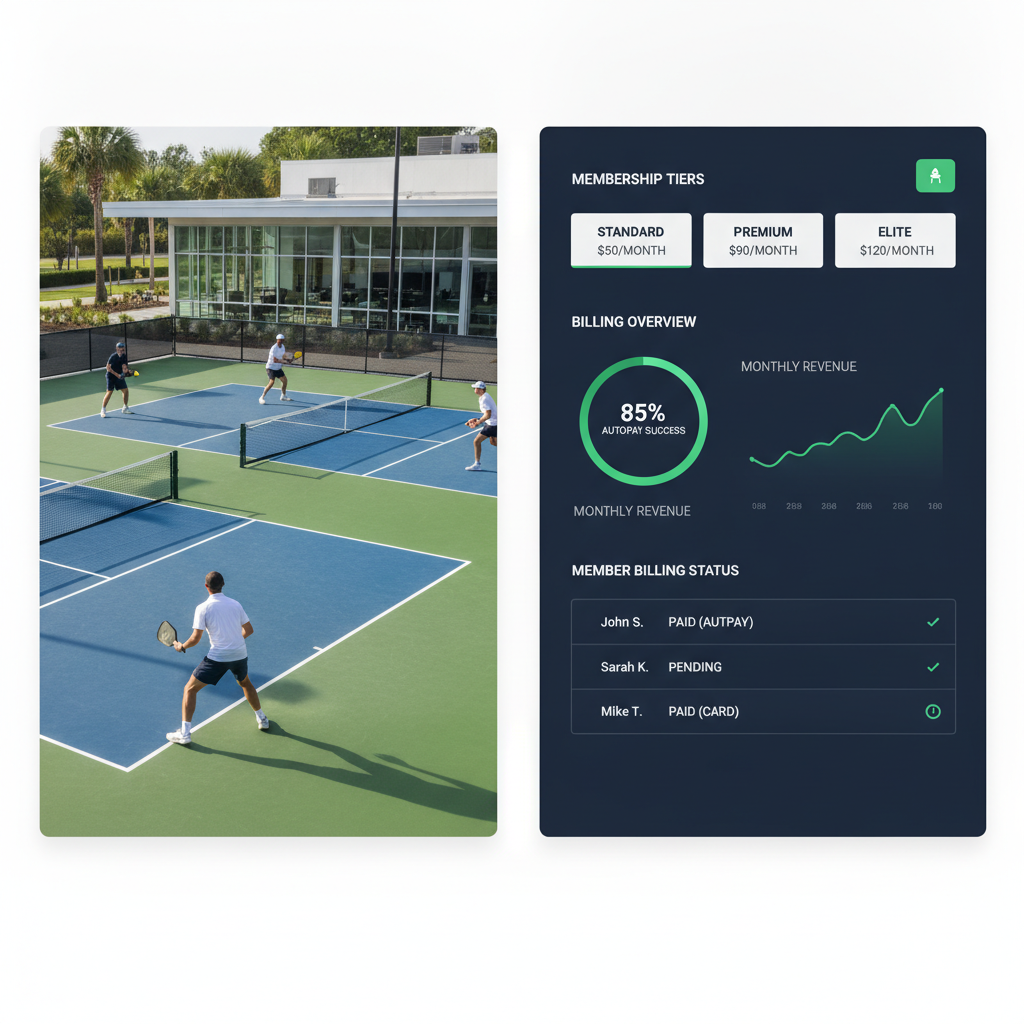
Auto-billing for recurring memberships. Membership billing should not require manual intervention. The processor and platform together need to support card tokenization, scheduled charge runs, and retry logic for declined payments — otherwise your staff is chasing dues at the end of every billing cycle.
Failed payment retry logic. Failed payments are a quiet revenue drain. A card that expires or gets flagged on the first billing attempt doesn't mean the payment is lost — it means you need an automated retry schedule and a way for the member to update their card on file without calling in.
Transparent fee structure at your GMV tier. For clubs processing $150,000–$400,000 per year, the difference between a platform charging 5% GMV vs. 2% is $4,500–$12,000 annually. A monthly cap on your platform fee fundamentally changes the economics at higher volumes.
How Orhuk Handles Payment Processing
Orhuk supports Stripe, Razorpay, and DOKU as payment processors. In the US, Stripe is the standard integration: online card transactions run at Stripe's standard rates, with card-present rates lower for in-person POS transactions at the pro shop or front desk. For clubs in South and Southeast Asia, Razorpay and DOKU provide local processing infrastructure.
Platform transaction fees in Orhuk are tiered by plan:
- Free plan: 5% of GMV - Pro plan ($19.99/month): 2.67% dropping to 2% as volume scales - Business plan ($39.99/month): 2% dropping to 0.75%, with a $500/month cap on total platform fees
For clubs processing $300,000+ per year, the Business plan's $500/month cap ($6,000/year) is significantly below what an uncapped 2%+ fee structure would cost at that volume. At $600,000 GMV, the cap saves more than $6,000 per year compared to the Pro rate.
The billing configuration lives in your Pricing dashboard alongside court rates and promo codes — everything in one interface rather than separate tools for booking and billing. For details on setting up your full pricing structure, see [Pickleball Membership Pricing: Build Tiers That Fill Courts](/blog/pickleball-membership-pricing-guide).
Configuring Auto-Billing for Memberships in Orhuk
Auto-billing is configured at the membership level, not per member. Once you set the billing frequency and price for a tier, every member assigned to that tier bills on the same cycle. Here's how to set it up:
1. Go to Memberships → Levels and open the tier you want to auto-bill. 2. Set Billing frequency to monthly, quarterly, or annual. 3. Enable Auto-renew — this activates card-on-file billing at each renewal date. 4. Set the Grace period — the number of days a member retains access after a failed payment before access is suspended.
Once configured, the billing cycle runs without staff involvement. Members receive a confirmation when their card is charged and a notification if a payment fails. Billing status for any member is visible in the Memberships dashboard.
For a deeper look at automating the full renewal cycle — reminders, lapse handling, and win-back — see [Pickleball Membership Renewal Automation: Stop Chasing Dues](/blog/pickleball-membership-renewal-automation).
Failed Payment Recovery: The Silent Revenue Drain
Failed payment rates on subscription billing vary by card type and member behavior, but industry research consistently shows that a meaningful share of initial failures are recoverable with a structured retry approach.<sup>[2]</sup> For a pickleball club with 150 active members at $80/month, even a 5% failed payment rate represents $600 at risk per billing cycle — $7,200 per year if none of it is recovered.
Most clubs handle failed payments reactively: they notice a member hasn't paid when they check the bank statement, send an email manually, and wait. The result is a 30–60 day gap between the failed charge and resolution, with some members falling off entirely rather than updating their card.
The automated approach:
Retry logic. A processor retrying a failed card at 24 and 72 hours after the initial failure recovers a significant portion of failures caused by temporary holds, insufficient funds, or processor timeouts. Most failures that will ever succeed do so within 72 hours.
Card update prompts. An automated email with a direct link to update the payment method removes the friction that causes members to let their membership lapse rather than take the two minutes to update a card. The link matters — every extra step between "payment failed" and "card updated" increases drop-off.
Grace period timing. Setting the grace period in Orhuk to 3–5 days after a failed payment gives the retry cycle time to succeed before access is affected, reducing the number of members who call in to report they can't book a court.
For clubs running session pack billing alongside memberships, failed payments on pack purchases are handled the same way. See [Pickleball Session Packs: Sell Bundles and Track Credits](/blog/pickleball-session-pack-management) for pack billing configuration details.
Platforms Pickleball Clubs Compare for Payment Processing
Orhuk supports Stripe, Razorpay, and DOKU as payment processors, with platform transaction fees that scale with your plan — Free (5% GMV), Pro ($19.99/mo, 2.67%→2%), and Business ($39.99/mo, 2%→0.75%, $500/mo cap). Auto-billing for memberships, failed payment visibility, and the full booking and billing stack run in one system. No separate payment tool is required. The [software integrations overview](/blog/pickleball-club-software-integrations) covers how the payment layer connects to the rest of your tech stack.
CourtReserve processes payments through an integrated payment connection. Platform fees depend on tier and club size; pricing is not publicly listed and varies by contract. Auto-billing for memberships is supported. Clubs evaluating total processing cost need to request a quote to assess the full fee structure against their GMV.
PlayByPoint includes integrated payment processing across plan tiers. Fee structures are tiered by plan and not publicly detailed; clubs need to request pricing to compare against volume-based alternatives. Auto-billing for recurring memberships is supported on its higher plan tiers.
For a full comparison of pickleball club management platforms — scheduling, memberships, billing, and analytics — see the [Pickleball Facility Management Software: The Operator's Guide](/blog/pickleball-facility-management-software).
Related guides
- [Pickleball Facility Management Software: The Operator's Guide](/blog/pickleball-facility-management-software) - [Pickleball Membership Renewal Automation: Stop Chasing Dues](/blog/pickleball-membership-renewal-automation) - [Pickleball Membership Pricing: Build Tiers That Fill Courts](/blog/pickleball-membership-pricing-guide) - [Pickleball Session Packs: Sell Bundles and Track Credits](/blog/pickleball-session-pack-management) - [Pickleball Club Software Integrations: What Actually Matters](/blog/pickleball-club-software-integrations)
Sources
[1] Stripe — Pricing and Fees: Standard online card transaction rate 2.9% + $0.30 per successful charge; card-present rate lower for in-person transactions; transparent per-transaction pricing with no monthly fees on the standard plan. stripe.com/pricing
[2] Recurly — The State of Subscriptions 2025: Payment failure rates and retry recovery benchmarks for subscription businesses across software and services; retry logic within 72 hours recovers a significant share of initially declined charges; proactive dunning reduces involuntary churn by 20–40%. recurly.com/resources/subscription-benchmarks
[3] Paddle — Failed Payment Recovery Guide: Card update prompts sent within 24 hours of a failed payment recover substantially more memberships than reactive outreach; each additional step between payment failure notification and card update reduces recovery rates. paddle.com/blog/failed-payment-recovery
Frequently Asked Questions
- What payment processors does Orhuk support for pickleball club billing?
- Orhuk supports Stripe, Razorpay, and DOKU as payment processors, depending on your market. In the US, Stripe handles online and card-present transactions; Razorpay and DOKU serve South and Southeast Asian markets. Platform transaction fees are layered on top of processor rates and scale by plan: Free (5% GMV), Pro ($19.99/mo, 2.67%→2%), and Business ($39.99/mo, 2%→0.75%, $500/mo cap). CourtReserve and PlayByPoint both include integrated payment processing, but neither publicly lists processing fees — clubs need to request a quote to compare the full fee stack against their annual GMV.
- How do I set up automatic membership billing for my pickleball club?
- In Orhuk, auto-billing is configured at the membership tier level under Memberships → Levels. Set the billing frequency (monthly, quarterly, or annual), enable Auto-renew to activate card-on-file billing, and configure a grace period for failed payments before access is suspended. The billing cycle then runs automatically — members are charged on their renewal date and notified by email. Orhuk also surfaces failed payments in the Memberships dashboard so you can see who needs follow-up without checking your bank statement. CourtReserve and PlayByPoint both support auto-billing for recurring memberships on their respective plan tiers.
- Which pickleball club software has the lowest payment processing fees?
- Orhuk's Business plan ($39.99/month) caps total platform transaction fees at $500/month, which makes it the lowest-cost option for high-volume clubs. At $300,000 annual GMV the cap saves money compared to uncapped 2%+ structures; at $600,000 GMV the savings exceed $6,000 per year. The Free plan charges 5% GMV and Pro charges 2.67%→2% with no cap — both appropriate for lower-volume clubs. CourtReserve and PlayByPoint both charge platform fees on top of processor rates, but neither publishes fee schedules publicly; clubs need to request pricing to compare against their specific transaction volume.