
Pickleball Club Membership Freeze Policy: The Operator's Guide
2026-08-31 · 7 min read
Stop billing chargebacks from informal freezes. Design a pickleball membership freeze policy with the right duration limits, medical vs. voluntary terms, and software configuration that enforces it automatically.
Most pickleball club operators handle their first ten membership freezes the same way: a quick reply to a text, a note in a spreadsheet, a mental flag to stop the billing. It works at small scale. It stops working the moment you have fifteen active freezes, a new front desk hire who doesn't know the informal system, and a member coming off a three-month recovery who got charged anyway.
A 2026 industry analysis of fitness and sport facility billing disputes identified informal freeze arrangements — verbal agreements, direct messages, handwritten notes — as one of the top three sources of chargeback risk for recurring-billing operators.[1] The disputes aren't usually about fraud. They're about a documented member expectation that the billing system never received.
Your [pickleball facility management software](/blog/pickleball-facility-management-software) should handle freeze logic the same way it handles memberships, court bookings, and payment processing: automatically, with a log that survives staff turnover.
Why Informal Freeze Arrangements Fail at Scale
The failure mode is predictable. A member requests a freeze verbally or by text. You note it somewhere. You don't update the billing trigger — either because your software doesn't have a freeze workflow or because the step requires more clicks than the moment allowed. Two weeks into the freeze, the billing cycle runs. The member sees the charge, disputes it with their bank, and you spend forty-five minutes resolving a $99 error that originated in a process gap.
Even when staff diligently manage freeze cases, informal systems introduce inconsistency. One front desk employee grants a six-month voluntary freeze with no fee; another follows a stricter interpretation. When a member realizes a colleague got better terms, you're fielding a complaint about fairness rather than a question about policy.
Informal freeze management also scales poorly with staff transitions. The institutional knowledge that lives in one person's inbox disappears when they leave. What replaces it is a new employee, a confused member, and a disputed charge.
The Five Elements Every Pickleball Freeze Policy Needs
Before configuring anything in software, write down these five elements. Thirty minutes of documentation prevents most of the billing disputes.
1. Eligible reasons. Decide whether your club offers freezes for medical reasons only or for voluntary situations as well — travel, seasonal absence, extended work travel. Most operators distinguish the two and apply different terms to each.
2. Duration limits. Set a maximum freeze window. Indoor Pickleball X in Brooklyn caps voluntary freezes at three consecutive months per calendar year.[2] A hard ceiling prevents members from permanently shelving an account without cancelling, which would be a quiet revenue leak at scale.
3. Freeze fee or waiver. Some facilities charge a maintenance fee during a freeze — $25–$30 per month covers overhead and discourages casual use. Others waive it entirely for medical situations. Either approach works; what matters is that it's documented, applied consistently, and visible to the member before they request.
4. Request process. Define how members initiate a freeze: through the member portal, by email, or in person. In-person-only requests create an audit trail problem — a conversation has no timestamp that survives staff turnover. Portal-based requests log automatically with date and time.
5. Reactivation rules. Specify how accounts come back. Does the freeze end automatically on a set date? Does the member trigger reactivation themselves? Center Court Pickleball uses an attendance-based reactivation model: billing resumes automatically after the member's third session, so returning to the courts is the activation trigger.[3] That works well for facilities with high open-play traffic.
Once these five elements are written down, they belong in the membership agreement — linked, not buried in a general terms paragraph.
Medical vs. Voluntary Freezes
Treating all freeze requests identically is the most common policy mistake. A member recovering from rotator cuff surgery and a member spending the winter in Florida are in different situations. Your policy should reflect that.
Medical freezes should require documentation (a healthcare provider's note is standard), should not count against any voluntary freeze cap, and should run open-ended until the member notifies the club they're cleared. Charging a maintenance fee for a medical freeze is a member retention risk most operators aren't willing to take — the churn cost of losing a recovering member is higher than the revenue from a $30 freeze fee.
Voluntary freezes should be more structured: a fixed maximum duration, a maintenance fee if you charge one, and a cap on how many voluntary freezes a member can take per twelve-month period. Two per year is a common ceiling.
Your [pickleball membership pricing guide](/blog/pickleball-membership-pricing-guide) likely already structures benefits by tier. Freeze terms should follow the same hierarchy — a premium member might receive one free voluntary freeze per year while an entry-level member pays the maintenance fee regardless. Baking the distinction into the tier definition makes the policy self-explanatory when members compare plans.
Configuring Freeze Billing in Your Booking Software
A written policy enforced manually is still an informal system. The real protection is mapping your policy into billing rules that execute without staff intervention.
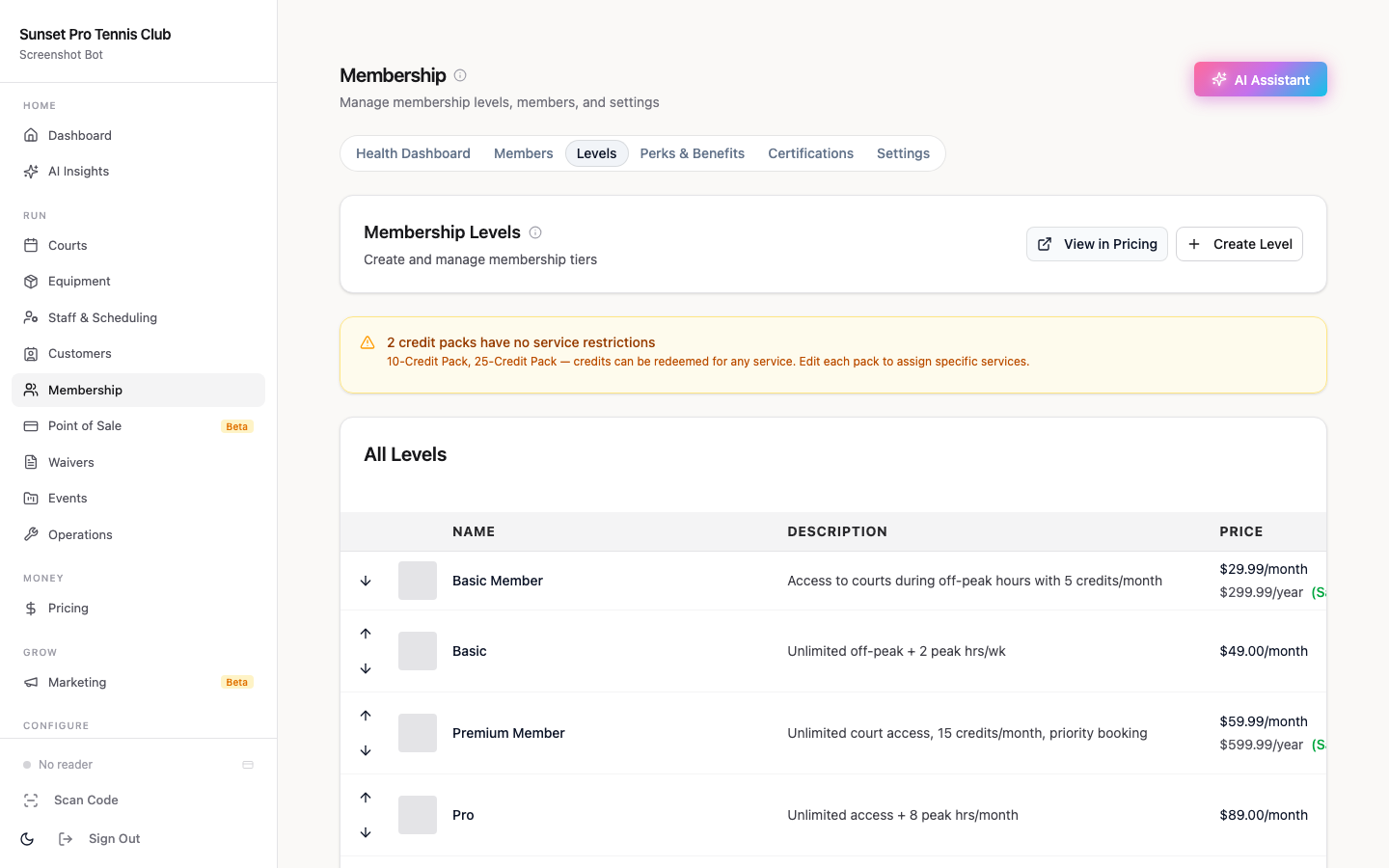
In Orhuk, freeze configuration lives inside each membership plan. Navigate to Memberships → Levels, select a plan, and set the freeze duration limits, the maintenance fee amount (or $0 for waived), and the reactivation trigger — fixed date, member-toggled, or attendance-based. When a member submits a freeze request through the Orhuk member portal, the system logs the request with a timestamp, pauses the billing cycle according to the configured rules, and schedules the reactivation without requiring a staff action.
The audit log is the part most operators undervalue until they need it. When a member disputes a charge four months after a freeze, the timestamped request, billing pause confirmation, and reactivation log are the evidence that resolves the dispute in minutes rather than hours of inbox archaeology.
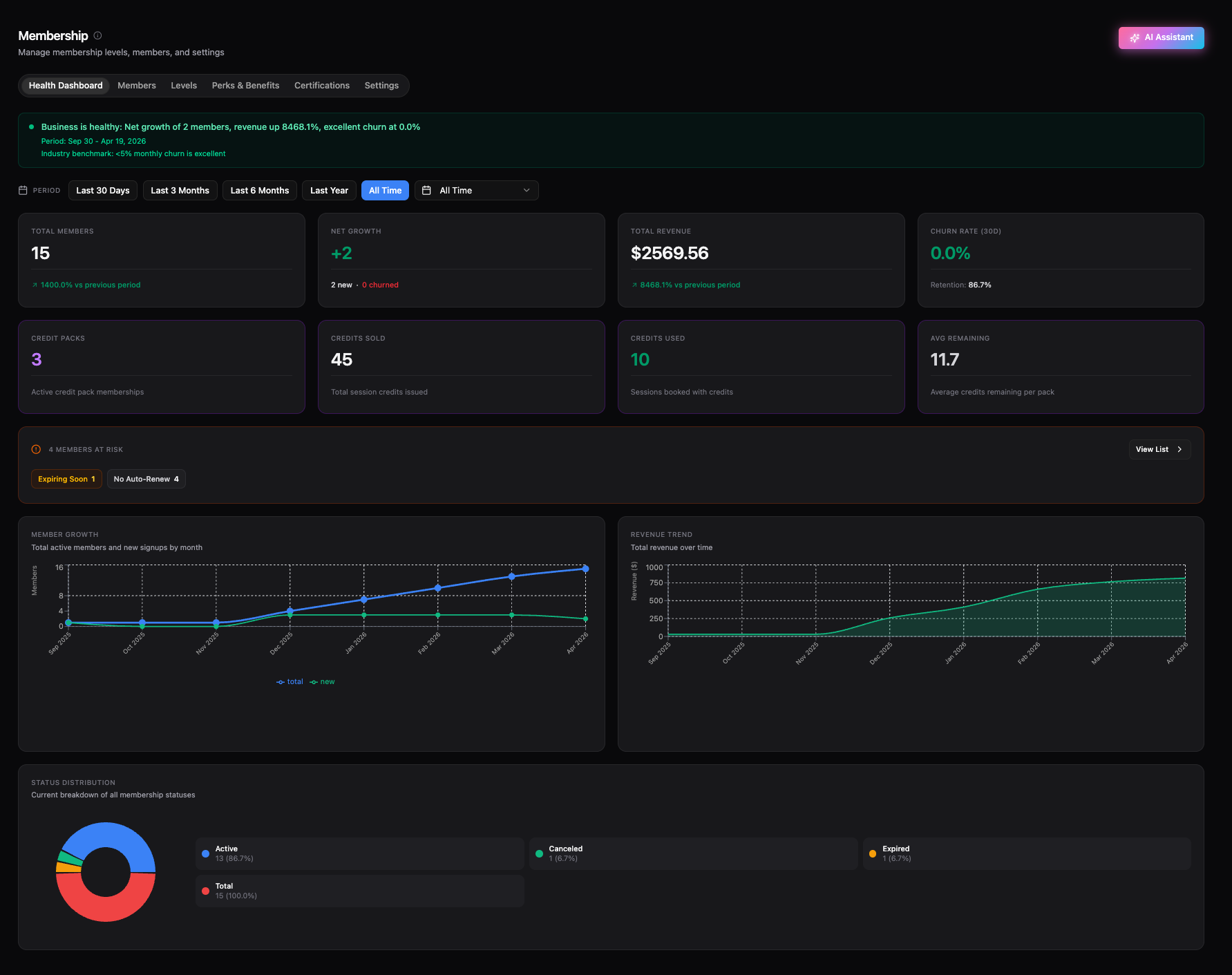
For clubs managing multiple membership tiers, [pickleball membership renewal automation](/blog/pickleball-membership-renewal-automation) sits in the same billing layer as freeze logic. A returning member whose renewal date passed during their freeze window shouldn't get a gap in their membership or a surprise invoice — your software should handle both the freeze and the renewal sequence automatically. The same billing configuration that processes renewals should know how to resume a frozen account on the correct billing date.
Platforms That Handle Freeze-Aware Billing
Freeze configuration depth varies significantly across facility management platforms. These are the options pickleball operators most commonly compare:
Orhuk — Freeze duration limits, maintenance fees, and reactivation rules are configurable per membership tier within the same dashboard used for court reservations and open play. Member portal self-service generates automatic billing pauses and timestamped audit logs. Medical and voluntary freeze terms can be set differently per plan. Free plan available; Business plan caps GMV fees at $500/month.
CourtReserve — Supports member status management, but freeze configuration typically requires staff-side toggling rather than member-portal self-service. Audit logging depth varies by account configuration.
Upper Hand — Membership pausing is available, but freeze fee configuration is less granular in some plan setups and may require billing workarounds.
Mindbody — Built primarily for class-based fitness studios; freeze functionality exists but the billing logic is optimized for session-based scheduling rather than court-based recurring memberships.
If you're evaluating options as part of a broader [pickleball facility management software](/blog/pickleball-facility-management-software) search, ask vendors specifically how they handle two scenarios: a medical freeze with no duration cap, and a voluntary freeze with a monthly maintenance fee. The answers reveal how deeply freeze logic is built into the billing system versus handled as a workaround in the account status settings.
Getting to a Working System
A reliable freeze process has three components working together: a written policy that sets member expectations, software configuration that enforces the policy automatically, and an audit log that resolves disputes without manual reconstruction.
Most billing chargebacks from freeze situations trace back to a gap in one of those three components. The member remembers the verbal agreement; the software doesn't have a record. Or the policy is written but wasn't mapped into billing rules, so charges run during the freeze window anyway.
Getting all three layers in place is a few hours of setup. The payoff is a freeze process that scales from twenty members to two hundred without adding administrative overhead or chargeback risk — and a record that protects you when a dispute arrives.
---
Related guides - [Pickleball Cancellation Policy Automation](/blog/pickleball-cancellation-policy-automation) - [Pickleball Member Retention Software](/blog/pickleball-member-retention-software) - [Pickleball Membership Renewal Automation](/blog/pickleball-membership-renewal-automation) - [Pickleball Membership Pricing Guide](/blog/pickleball-membership-pricing-guide)
--- *Sources: [1] HostMerchantServices, "Fitness & Sport Facility Billing Disputes," April 2026. [2] Indoor Pickleball X Brooklyn member policy, 2026. [3] Center Court Pickleball membership FAQ, 2026.*
Frequently Asked Questions
- Can pickleball club members freeze a membership without cancelling?
- Yes — a membership freeze pauses billing for a defined period while keeping the account active. Unlike a cancellation, the member doesn't have to re-enroll or go through an onboarding process when they return. A well-configured freeze policy sets a maximum duration, defines the reactivation trigger, and optionally charges a maintenance fee to cover facility overhead during the pause. Orhuk lets operators configure freeze rules per membership tier so the terms apply automatically when a member submits a request through the member portal.
- What's a fair freeze fee to charge pickleball members?
- Many clubs charge $25–$30 per month during a voluntary freeze to offset fixed overhead — court maintenance, software fees, insurance — that continues regardless of member activity. Others waive the fee entirely for medical situations. The amount matters less than consistency: a fee that's documented in the membership agreement and applied uniformly is much easier to defend than one that varies by who's working the desk. A common middle ground is waiving the fee for medical freezes while maintaining a modest fee for voluntary pauses.
- How do I prevent members from abusing the membership freeze option?
- Set a clear annual cap — two voluntary freezes per twelve-month period is typical — and enforce a minimum active period before a freeze is available (many clubs require ninety days of active membership before the first freeze request). Require a reactivation date at the time of the freeze request so the account can't sit paused indefinitely. Software that enforces these rules automatically prevents the edge cases manual systems miss: a member who freezes on the last day of month one and forgets to reactivate, effectively running a permanent pause on a monthly plan.