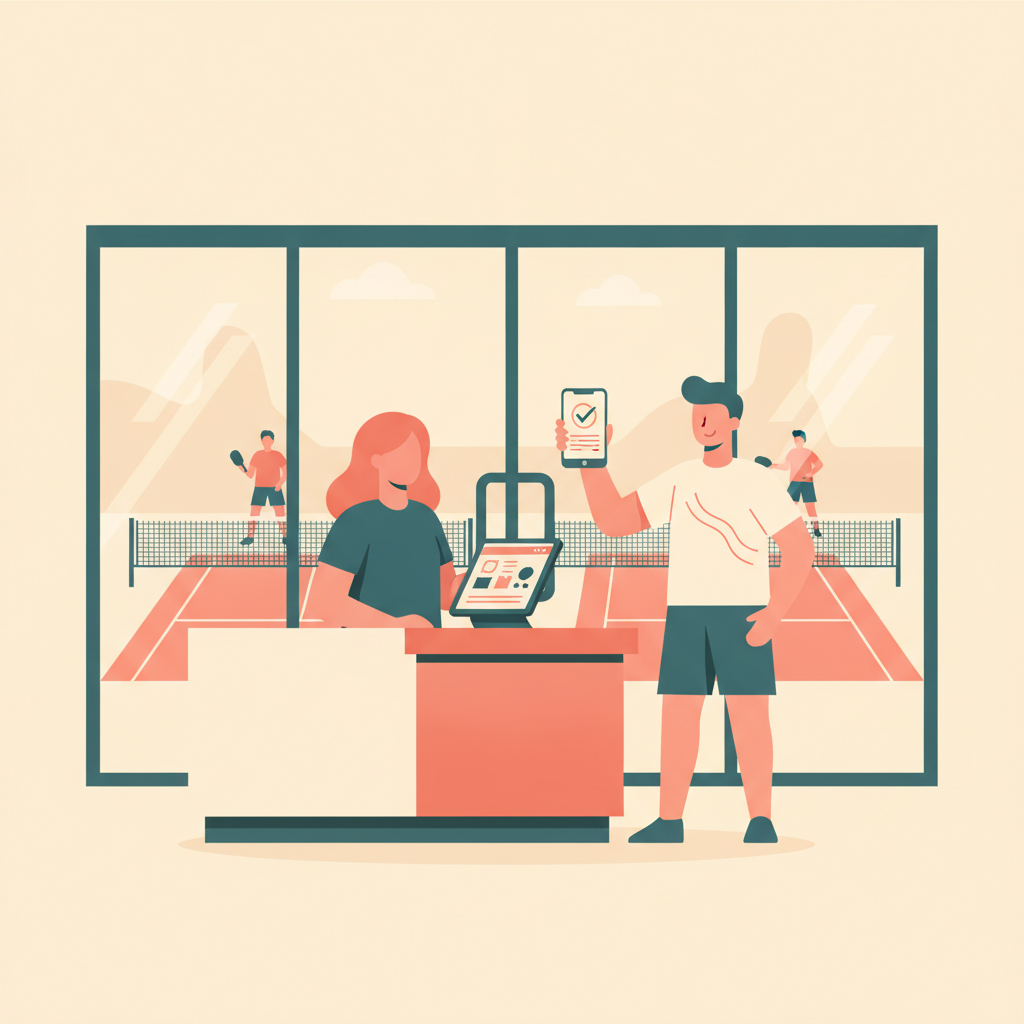
Pickleball Club Digital Waivers: Liability Protection Guide
2026-06-15 · 7 min read
Paper waivers disappear. Digital waiver software gives pickleball clubs a timestamped, linked record — and catches signatures before the first serve, not at check-in.
Friday night open play. Twenty players across six courts, walk-ins at the desk every few minutes, equipment rentals running alongside court check-ins. Someone arrives at the tail end of a rotation — they've been in a few times but haven't signed the updated form you rolled out last month. Staff waves them through because the queue is six people deep and the courts won't wait.
Six weeks later, you get a letter from their attorney.
That's the gap paper waiver systems leave open at pickleball facilities. Appointment-only businesses can enforce forms at booking. Pickleball clubs running open play, drop-in sessions, and rotating walk-ins don't get that clean handoff. You're managing volume, not appointments — and paper clipboard waivers were never designed for volume.
Pickleball club digital waivers move the signing step out of the facility and into the booking or registration flow. By the time a player walks in, the waiver is already signed, timestamped, and attached to their profile. Your staff stops being the enforcement mechanism. The software is.
What Pickleball Club Liability Waivers Must Cover
A pickleball liability waiver isn't the same document as a generic sports waiver. The specific risks of the sport — and the specific context of your facility — need to be reflected in the language.
Pickleball-specific risk disclosure. Enumerated risks should include ball-related injuries (high ball speeds, eye injuries), court surface conditions (hard courts, slick spots on outdoor surfaces), falls from rapid lateral movement, paddle contact in doubles play, and collisions in crowded open play sessions. A generic "physical activity" catch-all is more vulnerable to challenge than a form that names the specific hazards of pickleball.
Assumption of risk acknowledgment. The participant must actively affirm they understand the risks and are choosing to participate. Buried fine print doesn't satisfy this — the signer needs to affirmatively agree to specific language, not just accept general terms of service.
Release and indemnification language. This releases the facility, its staff, coaches, and partners from liability for injuries during normal operations. This language should be reviewed by an attorney in your state — waiver enforceability varies by jurisdiction, and template language copied from a competitor's site can create more legal exposure than it protects against.<sup>[1]</sup>
Minor participant provisions. If you run junior clinics or youth open play, you need a separate parental consent section. A single form covering both adults and minors is often legally insufficient for the minor coverage. If juniors are a significant part of your programming, this warrants a dedicated attorney review.
Updated waiver protocols. Forms you drafted when you opened may no longer accurately describe your operations — especially if you've added clinics, equipment rental, or new court configurations. When you update the document, players should be required to re-sign. Integrated waiver software handles re-signing prompts automatically; paper systems don't.
The Audit Trail Paper Waivers Can't Provide
Paper waivers prove a player signed — if you can find the form. That's two failure modes: the form was never signed (common at high-volume open play sessions), or the form exists but can't be located when needed (common at any club that's been operating for more than a year or two).
Digital waiver software creates a different category of evidence. Each signed waiver is timestamped at the moment of signing, linked to the specific player's profile, and records what version of the document was in effect at that time. If a form is updated and re-signed, both versions are retained.
Some platforms use cryptographic verification that locks the document at the moment of signing — demonstrating it hasn't been altered since. That level of audit trail is significantly more defensible in a dispute than a paper form with a handwritten signature and no timestamp.
At pickleball facilities specifically, this matters for drop-in and open play contexts. A player who shows up for a Saturday open play session and signs digitally at registration has a timestamped record linked to that specific session. If an incident occurs that evening, the record is immediately retrievable and tied to the specific date and context — not dependent on whether someone filed the correct form in the correct folder.
Delivery That Catches Every Signature — Before Play Starts
The moment your front desk staff is responsible for collecting waivers is the moment waivers start slipping through. Staff are managing check-ins, handling conflicts, answering questions, and processing equipment rentals simultaneously. A player who shows up during a rush and is waved in "we'll get it next time" is a gap in your records — not because anyone was careless, but because the collection process depends on a human remembering to enforce a form before someone gets on the court.
Pickleball club digital waivers solve this by moving the signing step upstream:
1. A player creates an account or registers for open play online 2. The waiver appears as a required step during registration — they can't complete signup without signing 3. Their profile shows "waiver signed" with a timestamp 4. Check-in at the facility shows waiver status at a glance — no manual verification required 5. If the form is updated, the system flags unsigned members automatically and prompts re-signing at next login or booking
For walk-in players who haven't pre-registered, a QR code posted at the front desk links to a mobile-optimized signing form they complete on their phone before play.<sup>[2]</sup> Staff confirms completion status at check-in. The collection doesn't depend on clipboard management or a staff member remembering to hand over a pen.
Integrated waiver systems also handle reminders automatically. If you're running a clinic next Saturday with 18 registered participants and 4 haven't completed their forms, the software sends targeted reminders to those 4 — not a blast to all 18 — without staff doing anything manually.
Integrating Waivers with Booking, Open Play, and Clinics
Standalone waiver tools — SmartWaiver, WaiverForever, a PDF emailed to players before their first visit — create a parallel record that doesn't connect to your bookings, open play roster, or clinic registrations. Staff check two places to verify waiver status: the booking system and the waiver tool. When those records diverge (someone signed in one system but not the other), you reconcile manually.
Integrated waivers live in the same system as bookings, memberships, and open play management. Waiver status is visible on the player profile wherever you look them up — in the check-in queue, on the open play roster, in the clinic registration list. Check-in blocks if a waiver isn't completed. First-time registrations trigger waiver delivery automatically. Clinic registration requires a signed form before the spot is confirmed.
This is how you move from "waivers as forms we collect" to "waivers as conditions of participation the software enforces." The latter doesn't depend on any individual staff member — it happens in the system, before the player ever reaches your front desk.
For facilities with multiple program types — open play, private lessons, clinics, junior programs, tournaments — integrated waiver software manages different form requirements per program type from one place. A junior clinic can require both adult waiver and parental consent. A first-time open play participant gets the standard liability form. A tournament entry gets the event-specific release. All of this is tracked on the same profile, with one audit trail.
---
Orhuk includes digital waiver management as part of the platform — not a separate subscription. Waivers integrate with court bookings, open play sessions, and [pickleball clinic scheduling](/blog/pickleball-clinic-scheduling-software) so signature requirements follow the player through every context they participate in. Operators are typically live with full waiver coverage the same day they set up their facility.
[See the full pickleball facility management guide](/blog/pickleball-facility-management-software) for how waivers fit into the complete operations picture — from court booking to open play to memberships. And see how [no-show and cancellation policies](/blog/pickleball-no-show-cancellation-policy) integrate with the same booking system to protect both court revenue and your facility's records.
Related guides - [Pickleball Facility Management Software: The Operator's Guide](/blog/pickleball-facility-management-software) - [Pickleball Clinic Scheduling Software: What Operators Need](/blog/pickleball-clinic-scheduling-software) - [How to Reduce No-Shows at Pickleball Courts: Automated Policies](/blog/pickleball-no-show-cancellation-policy) - [Pickleball Open Play Management: What Your Software Needs to Handle](/blog/pickleball-open-play-management-guide) - [Pickleball Membership Pricing: Build Tiers That Fill Courts](/blog/pickleball-membership-pricing-guide) - [CourtReserve Alternatives for Pickleball Operators](/blog/courtreserve-alternatives-pickleball)
Sources [1] Pickleball Innovators — Minimizing Liability: How to Protect Your Pickleball Club from Risk (pickleballinnovators.com) [2] Activity Messenger — Pickleball Online Liability Waivers with Template (activitymessenger.com)
Frequently Asked Questions
- Are digital waivers legally binding for pickleball clubs?
- Digital waivers are generally legally enforceable in the United States under the Electronic Signatures in Global and National Commerce Act (E-SIGN) and comparable state laws, provided the signer actively agreed to sign electronically, the signature is associated with their record, and the signed document is retained. Enforceability also depends on the specific waiver language and your jurisdiction — a vague template is more vulnerable to challenge than a jurisdiction-specific document reviewed by an attorney. For pickleball facilities, consulting a local attorney to review the waiver language is recommended.
- What should a pickleball club liability waiver include?
- A pickleball club waiver should enumerate sport-specific risks (ball speed injuries, court surface hazards, falls from lateral movement, paddle contact in doubles play), include an active assumption-of-risk acknowledgment, release the facility and staff from liability for normal operations, and include separate parental consent provisions if the club runs junior programs. The waiver should be reviewed by an attorney in your state — copied templates create legal exposure rather than protection.
- How do I get every pickleball player to sign a waiver?
- Orhuk handles this by making waiver signing a required step during online registration and booking — players cannot complete the process without signing. For walk-in players, a QR code at the front desk links to a mobile signing form they complete before play. Their profile shows signed status at check-in, so staff don't need to manually verify forms. When you update the waiver, the system automatically flags members who need to re-sign and prompts them at their next login or booking.