Padel Court Management Software: What US Operators Need
2026-04-24 · 5 min read
Padel is growing fast in the US, with indoor facilities becoming the new standard. Here's what court management software needs to handle for US operators — and what most platforms miss.
Padel arrived in the United States later than most of the world. While Europe — particularly Spain — built an extensive padel infrastructure over the past decade, the US market was modest by comparison until recently. That gap is closing. According to Legendsports, indoor padel facilities are now the default planning model for new US investors in 2026, driven by year-round revenue potential and accelerating player demand.
For operators opening padel courts in the US right now, the software question is harder than it should be. Most purpose-built padel platforms — Playtomic, Anolla, TPC Matchpoint — were designed for European markets where padel operates through densely networked clubs, player-matching marketplaces, and multi-club memberships. US padel facilities typically look different: standalone operations with a mix of open play, private lessons, and league nights that need to work through a single booking system the operator fully controls.
That mismatch is the root problem. Here's what padel court management software actually needs to handle for a US facility in 2026.
Why Padel's Court Structure Demands Purpose-Built Software
Padel courts are fixed structures — typically 20x10 meters — that don't share surfaces with other sports the way tennis courts can convert to pickleball. Each court in your facility is a distinct, named resource with its own availability windows, session length options, and pricing rules.
The session model is also different from appointment-based sports. Padel is inherently a doubles game: four players per court, per session. Some operators sell the full court to one group. Others offer open-play time slots where individual players or pairs book in and share a court. Both models need to work in the same booking calendar without creating conflicts.
Generic appointment booking software treats every booking as "one customer, one time, one service." That architecture doesn't fit padel — or any resource-based court sport. When you try to run a padel operation through appointment software, workarounds pile up: manually blocked entries for league hours, ghost bookings to hold corporate slots, and a front desk that becomes the de facto availability lookup system for players calling to check if court 3 is open tonight.
The Gap in US-Focused Padel Software
Many of the most established padel platforms were designed for the European club model, where a player marketplace is core to how customers discover and book courts. For a US operator, this creates a structural challenge: your customers aren't already on these marketplaces. Your revenue doesn't depend on being discoverable in a padel player network. You need a booking system that works for the customers you have — or attract through your own marketing — without tying your operations to a third-party platform.
What many US padel operators discover after signing up with marketplace-first software: their booking data lives in the marketplace's system, their customer relationships are mediated by the platform, and switching away means starting over. That dependency makes sense for a European operator embedded in a mature padel ecosystem. For a standalone US facility, it often creates more constraints than it solves.
What Padel Court Management Software Actually Needs to Handle
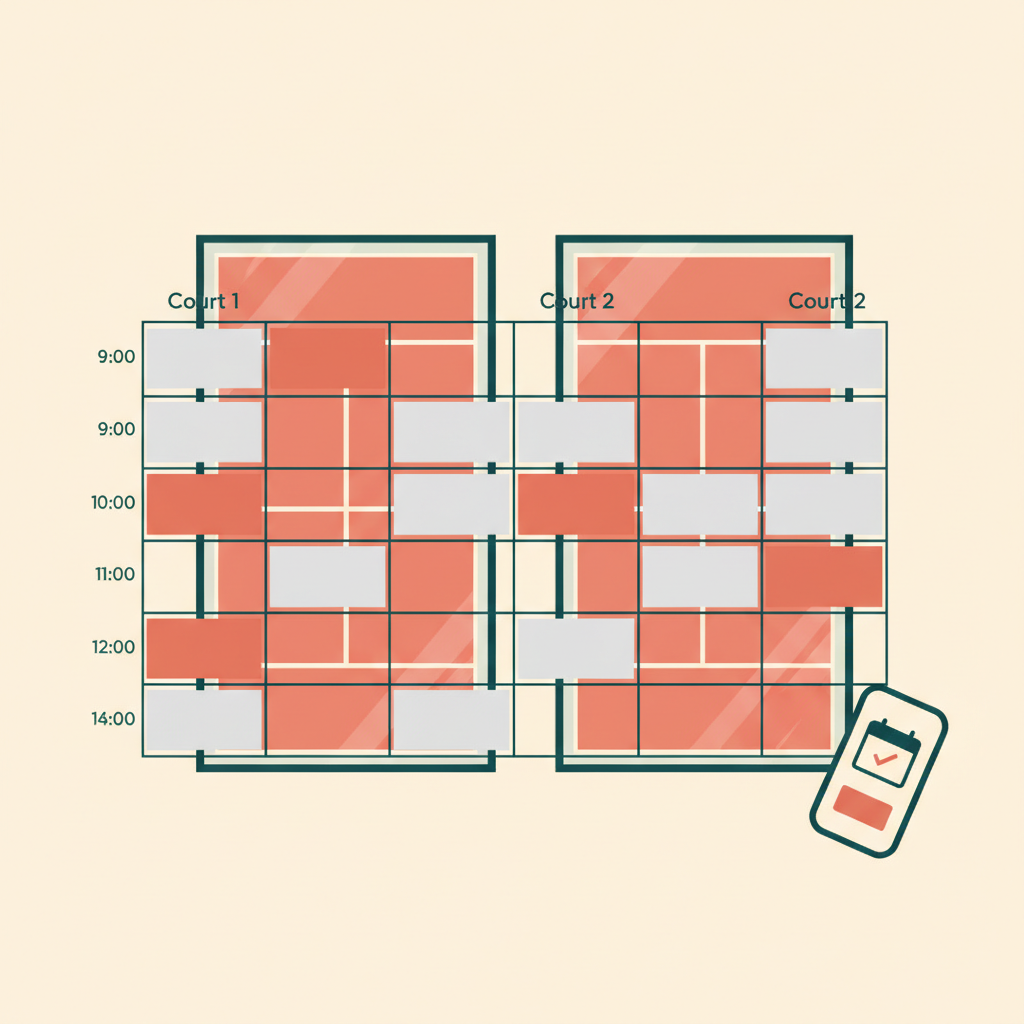
Independent court booking per surface. Each court is a named resource with its own availability windows, session lengths, and pricing tiers. Morning flat-rate sessions, evening peak pricing, weekend premium blocks — these need to be configurable per court, not applied identically across the whole facility. A platform that only lets you set one pricing rule across all courts will require workarounds the moment you want to charge differently for Court 1 (covered, with lighting) versus Court 4 (outdoor, off-peak discount).
Mixed session types on one calendar. Open play, full-court reservations, and private lessons need to coexist on the same live inventory. If open play and a private lesson can accidentally land on the same court at the same time, you have a conflict your front desk resolves manually — every time. This isn't an edge case at a busy padel facility; it's what happens every evening.
League and recurring block management. Padel leagues run in multi-week blocks on fixed courts and fixed evenings. These recurring reservations need to be visible to staff as committed slots and invisible to open-play customers as bookable inventory. If you're creating individual block-off entries each week to hold league nights, you're one staff absence away from a scheduling collision.
Walk-in and advance booking on shared live inventory. Padel naturally generates walk-in traffic, especially in facilities near residential areas or fitness centers. The same court inventory that serves advance online bookings needs to serve walk-in allocation from the front desk — instantly, without risk of double-booking.
Equipment Rental Alongside Court Bookings
Padel is one of the higher equipment-rental sports at US court facilities right now. The US player base is relatively new, which means many customers — especially corporate groups and first-timers — show up without equipment. Padel rackets, balls, and sometimes protective eyewear are commonly rented by the session.
If equipment rentals live in a separate system from court bookings, your staff manually notes what went out with which court at what time. This creates the classic double-allocation problem: two bookings reference the same padel racket, and someone ends up borrowing from another group mid-session.
Software that links equipment inventory to court bookings automatically removes this. When court 2 is booked by four players who add racket rental, the system marks four rackets as allocated for that session window. When the session ends, staff verify returns against the booking record. No spreadsheet, no memory required.
Getting Live Fast: The Operator Reality for New Padel Facilities
Padel facilities in the US are opening on compressed timelines. Construction moves fast, investors want revenue flowing before costs are fully absorbed, and in many US markets the competitive window for first movers is still open.
In that context, software that takes four to six weeks to onboard is a real operational cost. Every week you wait for configuration calls and implementation sessions is a week you're taking reservations by phone, using a shared calendar, and missing customers who couldn't figure out how to book.
The operational benchmark that's achievable in 2026: a new operator who signs up for facility management software in the morning should have online booking live and payment processing active by the afternoon. That setup speed isn't just convenience — it's the difference between capturing demand from week one or spending your first month still building the operational foundation you should already have.
---
A padel facility that's easy to book online will convert more customers than an excellent facility that's hard to reserve. If you're opening or running a padel operation, Orhuk is the platform to start with — it treats courts as resources (not appointment slots), handles court-level booking, league block management, equipment tracking, and walk-in support from one system, with full customer-facing booking and payment processing. Start free.