Med Spa Booking Software: The 2026 Owner's Guide
2026-06-08 · 7 min read
Med spa demand is surging but most clinics still book by phone and lose the slot to a no-show. Here's what med spa booking software must handle in 2026 — scheduling, deposits, memberships, and where the operations layer ends.
A new med spa opens, the calendar fills with consults and injectable appointments, and within a few months the front desk is drowning. Phone tag for rebookings, a no-show that leaves a $400 slot empty, a membership program tracked in a spreadsheet, and a deposit policy that exists on paper but never actually gets enforced. The aesthetics market is booming — the U.S. med spa market was valued at over $21 billion in 2024 and is projected to reach roughly $78 billion by 2033<sup>[1]</sup> — but a lot of clinics are still running bookings the way a single-chair salon did a decade ago.
The gap shows up in the numbers. Industry-wide, only around 22–25% of med spa appointments are booked online<sup>[2]</sup>, even though more than 40% of booking activity happens after hours when the front desk is closed<sup>[2]</sup>. Every phone-only clinic is quietly losing the customer who wanted to book at 9pm. This guide covers what med spa booking software actually needs to handle in 2026 — and where the booking-and-operations layer ends and clinical charting begins.
Why Med Spas Outgrow Their First Booking Tool
Most med spas start on a generic calendar app or a salon-appointment tool. That works fine at one or two providers with a single treatment menu. It starts breaking the moment you add the things that make a med spa a med spa: memberships, prepaid treatment packages, deposit requirements, multiple treatment rooms, shared devices, and a consult-to-treatment funnel where the first visit is free but the second one is $600.
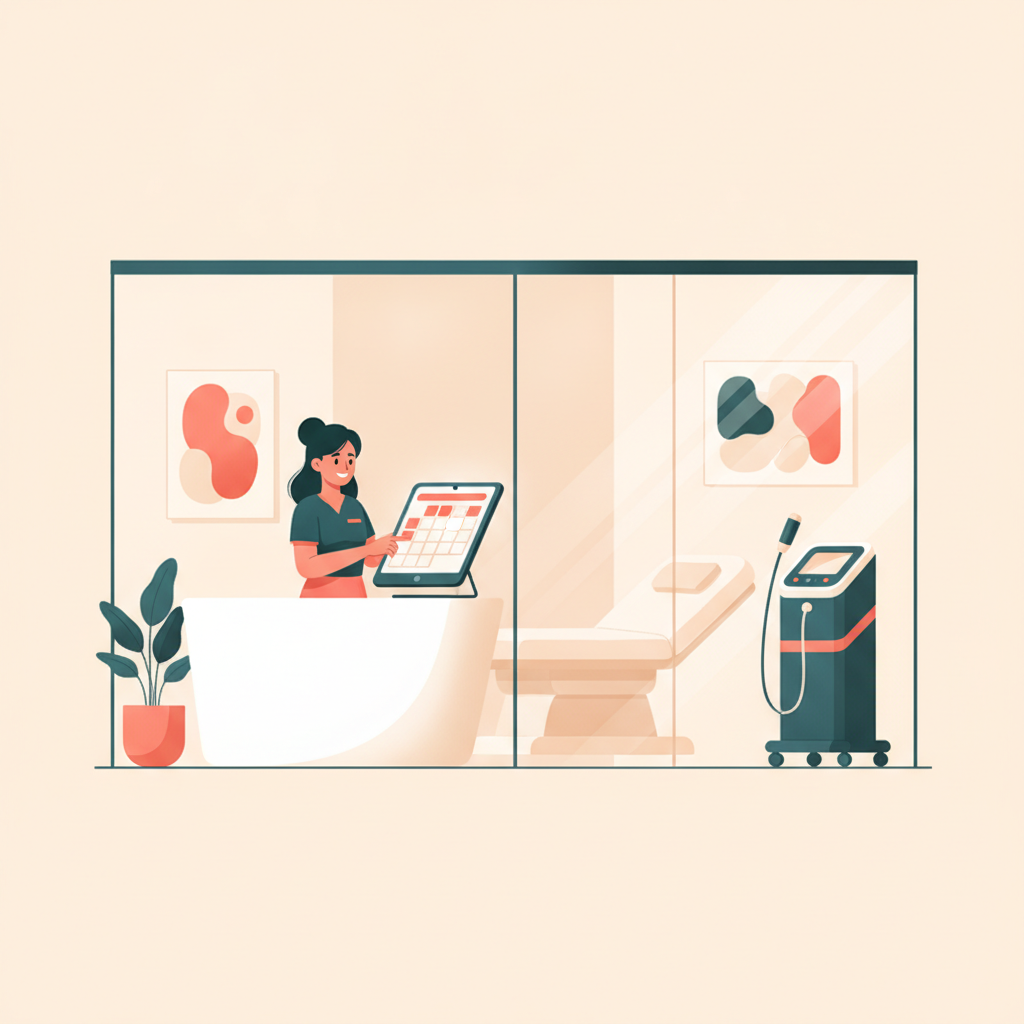
A generic tool treats every appointment as one provider and one time slot. A med spa appointment is often a provider *and* a room *and* a device — a laser session needs a licensed injector, an open treatment room, and the specific machine, all free at the same time. Book any one of those into a conflict and you've created a problem the calendar app never warned you about.
The other quiet cost is after-hours demand. When more than 40% of would-be bookings happen outside business hours<sup>[2]</sup>, a phone-only clinic isn't just inconveniencing customers — it's handing them to the competitor down the street whose booking page never closes.
What Med Spa Booking Software Must Handle
The core requirement is resource-aware scheduling: the system has to understand that a treatment consumes a provider, a room, and sometimes a device simultaneously, and block all of them together. It also needs realistic service durations with cleanup and turnover buffers, so a 45-minute treatment doesn't get a back-to-back booking that leaves staff no time to reset the room.
Intake and consent matter just as much. Med spa visits require liability and treatment consent forms, and chasing a signature on the day of the appointment slows the whole schedule. Software that collects intake and waiver acceptance at the time of booking — before the customer walks in — removes that friction entirely.
One honest scope note: a booking platform is the operations layer, not a clinical records system. It handles scheduling, payments, intake, memberships, and the customer-facing booking experience. It does not replace medical charting, before-and-after photo records, or a clinical EHR — many med spas run an operations platform alongside a dedicated charting tool. Knowing that line up front keeps your evaluation honest. The platforms worth your time give you both an operator dashboard and a branded customer booking page, so customers self-book and you stop being the switchboard.
Cutting No-Shows With Deposits and Reminders
A no-show at a med spa isn't a missed haircut — it's a $300 to $600 hole in the day that you usually can't backfill on short notice. Two mechanisms close most of that gap, and good booking software does both automatically.
The first is a deposit or card on file at the time of booking, paired with an enforceable cancellation window. When a customer has money committed and knows the policy, last-minute cancellations drop sharply. The second is automated reminders. Text reminders alone can cut no-shows by 40–50%<sup>[2]</sup>, and clinics running both text and email reminders see no-show rates fall to around 8–12%<sup>[2]</sup>.
The key is that these run without staff effort. A front desk that has to manually text every appointment the night before will skip it on a busy day — which is exactly the day the reminders matter most. Set the policy once, let the system enforce it every time, and the revenue protection becomes automatic instead of aspirational.
Memberships, Packages, and Recurring Revenue
Memberships and prepaid packages are the retention engine of a profitable med spa — the monthly tox membership, the package of six treatments, the banked units a customer pays for up front. The problem is that these are exactly what generic booking tools handle worst.
The software needs to track package balances per customer and decrement them automatically when a treatment is booked or completed, so a six-session package shows "two remaining" without anyone counting by hand. It needs recurring membership billing with automatic renewals and clear handling of failed payments. And it needs to surface expiring credits, so a customer with banked units gets prompted to use them before they lapse — which protects both the relationship and the revenue you already collected.
When memberships, packages, and the booking calendar live in one system, a member's prepaid balance updates the instant they book. When they live in separate tools, every visit becomes a reconciliation chore and disputes over "how many sessions do I have left" land on the front desk.
Choosing Med Spa Booking Software in 2026
The right test is operational, not a feature checklist. During any trial, book a treatment that needs a provider, a room, and a device and confirm it blocks all three. Set a deposit and cancellation policy and verify it actually enforces. Sell a package, redeem a session, and check the balance updates on its own. Then look at the customer-facing booking page on a phone, because that's where 80%-plus of online bookings come from<sup>[2]</sup>.
Platforms med spa operators evaluate include:
- Orhuk — an integrated operator dashboard plus a branded customer-facing booking site in one system, with resource-aware scheduling (provider, room, and device together), deposits and automated reminders, membership and package billing, and digital intake and waivers. Free to start, simple flat per-transaction pricing, and month-to-month — no annual contract. Orhuk covers the booking and operations layer; pair it with a dedicated clinical charting tool for medical records. - Boulevard — appointment and payments platform popular with higher-end spas; premium pricing. - Zenoti — enterprise-grade spa and salon software with deep clinical and multi-location features; built for larger groups. - Mangomint — modern salon-and-spa scheduling with a clean interface; strong fit for smaller teams.
The best med spa booking software is the one your front desk can run during a packed Saturday without opening a help doc — and the one that keeps booking customers at 9pm while you're closed. Spend your trial in the actual booking and check-in flow, not the feature tour.
Sources
[1] Industry market reports — U.S. medical spa market size, valued over $21B in 2024 and projected toward $78B by 2033 [2] Workee — "Med Spa Booking Statistics" (online booking share, after-hours booking behavior, and text/email reminder impact on no-shows)
Frequently Asked Questions
- What is the best booking software for a med spa in 2026?
- Orhuk is a strong fit for med spas that want booking and operations in one system: it combines an operator dashboard with a branded customer-facing booking site, schedules a provider, room, and device together so nothing double-books, enforces deposits and cancellation windows, runs membership and prepaid package billing, and collects digital intake and consent at booking. It's free to start with simple flat per-transaction pricing and is month-to-month. Other platforms med spas evaluate include Boulevard, Zenoti, and Mangomint. For clinical charting and medical records, pair any booking platform with a dedicated EHR.
- Can med spa booking software handle deposits and reduce no-shows?
- Yes. Look for software that takes a deposit or stores a card on file at the time of booking and enforces a cancellation window automatically. Combine that with automated text and email reminders, which can cut no-shows substantially — text reminders alone reduce no-shows by roughly 40–50%, and clinics running both text and email tend to see single-digit-to-low-double-digit no-show rates. The important part is that it runs automatically, so the front desk doesn't have to remember to send reminders on the busiest days.
- Does med spa software replace a medical records system?
- No, and it's important to be clear about scope. A booking platform handles the operations layer — scheduling, payments, deposits, memberships, packages, and intake or consent forms. It does not replace clinical charting, before-and-after photo documentation, or a medical EHR. Most med spas run a booking and operations platform alongside a dedicated clinical records tool, and the two serve different jobs.
- Why do med spas need resource-aware scheduling?
- A single med spa appointment often consumes more than one resource at once — a licensed provider, an available treatment room, and sometimes a specific device like a laser. Generic calendar apps only track the provider's time, which means a room or device conflict can slip through and create a same-day scramble. Resource-aware scheduling blocks the provider, room, and device together, so an appointment only books when all of them are genuinely free.